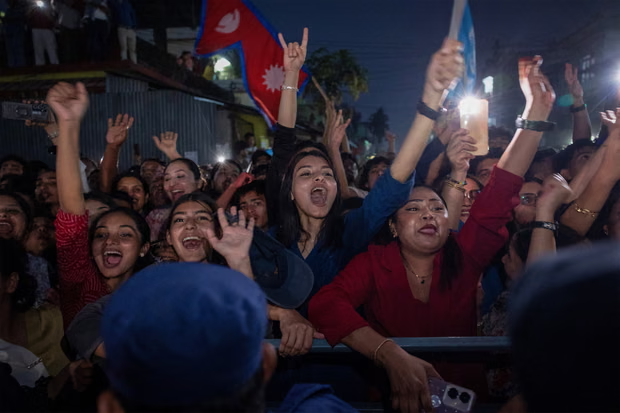
Balendra Shah, the rapper turned politician and popular figurehead of a gen Z revolution, looks set to become Nepal’s next prime minister after his party won by an unprecedented margin.
Shah, known widely as Balen, and his Rastriya Swatantra party (RSP) secured a rare landslide victory in the first election since youth-led protests during which dozens were killed and the former government was toppled.
“It is the victory of hope and change,” said Ramesh Paudyal, a senior RSP leader. “It is the most beautiful endorsement of the gen Z movement. The true tribute to the gen Z martyrs will be expressed through the work carried out every day by the government led by Balendra Shah.”
The public upset and anger at the political old guard was evident in the results, with veteran parties and their leaders losing vast numbers of seats. Balen’s RSP, which was formed only three years ago by a former TV executive, was handed a rare outright majority.
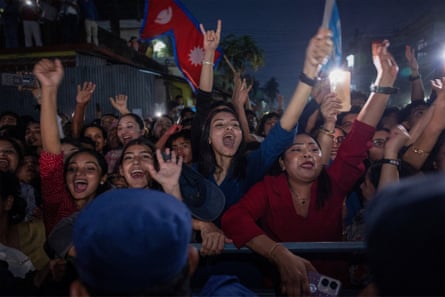
Nepal’s electoral system – which combines a first past the post system with proportional representation – has tended to result in weak coalition governments. But as counting reached its final stages, RSP had won at least 122 out of 165 direct seats and was leading in three more, putting the party on course for the biggest electoral majority since Nepal became a democracy.
The final election results, which will include additional seats appointed through proportional representation, are expected in the coming days.
The contest was considered one of the most significant and gripping in years, pitting the heavyweights who have dominated Nepal’s politics for decades against a younger generation pledging to end corruption and bring about a fresh start for the country.
Despite being relatively new to politics, Shah, 35, had been seen as the frontrunner, running a dynamic campaign that tapped into the hunger for change, particularly among young Nepalis.
An engineer by training, Shah rose to fame as a rapper whose tracks took aim at poverty, unemployment and corruption. In 2022, he pivoted to public office, running independently to become the mayor of Kathmandu. After winning a strong majority, he began the mammoth task of cleaning up the city, including removing unauthorised buildings and sorting out rubbish.
But it was the youth uprising in September last year that elevated Shah to national prominence. After protests suddenly erupted, sparked by a ban on social media but driven by a larger frustration at lack of opportunities, the government hit back with force and 19 protesters were killed.
The uprising spiralled into wider unrest and arson attacks that left 70 dead, and resulted in the resignation of the government led by the four-time prime minister KP Sharma Oli and his veteran Communist party.
The speed at which the government was toppled left many in the movement in shock. Shah was the favoured choice by the gen Z protest leaders to become interim prime minister, but he declined and instead chose to wait to run until formal elections were held on 5 March.
In a symbol of the battle between the old guard and the new generation, Shah chose to stand in the Jhapa-5 constituency, running directly against 74-year-old Oli.
Shah’s overwhelming victory was finally declared on Saturday night: by 68,348 votes to 18,724 for Oli. As he conceded victory, the former prime minister said he wished Shah an “uninterrupted five-year term, heartfelt best wishes”.
Arriving to pick up his certificate of election in his signature dark sunglasses and black blazer, Shah emerged from the sunroof of his vehicle and held up a banner bearing the words: “Congratulations to all of you, this is your victory.”
In Jhapa-5, there was much jubilance at his win. “One of the main factors behind the gen Z movement, KP Oli, has been defeated. It feels like justice has been delivered to the martyrs,” said Aditya Karna, 23. “Now there is an expectation that Balen will lead the country toward a better future.”
Bhawana Raut, a leader of the gen Z movement in Jhapa, said the result meant there could finally be “healing” after the violence unleashed in the September protests. “This sends a clear message to everyone who comes to power: you must be accountable,” he said. “Even leaders who rose after such a huge struggle can be brought down to zero by voters in a single moment. The government must be a servant of the people, not a ruling authority.”
Nonetheless, analysts emphasised that Shah had a daunting task head of him, including managing the high expectations placed upon him by the younger generation. Among the promises made during his campaign was to investigate and prosecute previous leaders for entrenched corruption, and the Oli government for its role in killing gen Z protesters.
“The public has many aspirations and many desires,” said the political analyst Lok Raj Baral. “They have placed extremely high hopes, but in a country like Nepal it is very difficult to deliver. The bureaucracy remains the same old one, only the political leadership is new.”
With Nepal landlocked between India and China – whose competing interests have often run roughshod over domestic needs – many emphasised how important foreign policy would be in Balen’s premiership.
Baral added: “They won a majority largely because they convinced people that they would work for good governance. That mandate is positive. But from the moment Balen becomes prime minister, challenges will be waiting for him at every step.”