New IRGC chief tasked with saving Iran from civil war
New IRGC chief tasked with saving Iran from civil war
He was once tasked with exporting Iran’s Islamic revolution across the Middle East and beyond through dozens of armed proxies.
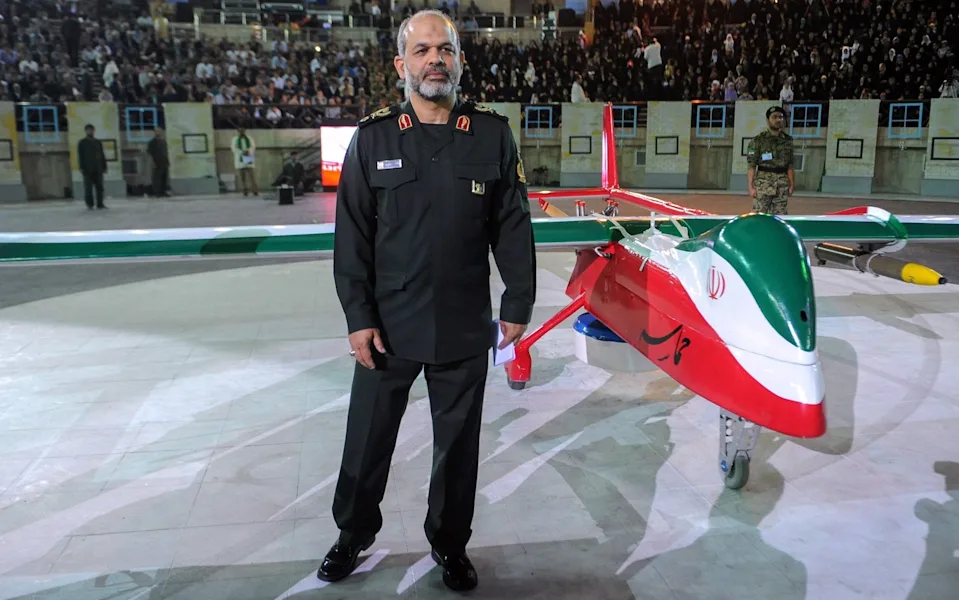
But Ahmad Vahidi, the new chief of Iran’s Islamic Revolutionary Guard Corps (IRGC), must now focus on a job much closer to home: preserve the regime and stop his country of 93 million people from falling into a civil war.
Facing CIA-backed plots to overthrow the Islamic republic, Baluch militants in the south-east, and Arab grievances in the south-west, as well as relentless air strikes from the United States and Israel, Tehran needs a commander who can crush separatist movements and maintain control.
Mr Vahidi will bring that expertise to the IRGC, the all-powerful branch of Iran’s armed forces in charge of national security.
Appointed as commander of the Quds Force, the IRGC’s external operations arm, in 1988, the 67-year-old was instrumental in building up Hezbollah in Lebanon, Houthis in Yemen, Hamas in Gaza and Iraqi and Syrian militias.
He knows which tribal leaders respond positively to co-option and which to coercion. He understands proxy warfare and how to manage non-Persian militia.
This expertise matters more now than tactical brilliance, with his appointment signalling that avoiding civil war is more important to Tehran.

Resources will focus on maintaining control in ethnically sensitive regions and suppressing separatist activity, as the IRGC’s recent statements have indicated.
On Thursday, it warned that any “terrorist or separatist activity” would be “suffocated in the cradle” and threatened “destruction” for anyone invading Iran.
“Enemies and deceived counter-revolutionary elements should know … that if they commit evil against Iran, they will [face] complete destruction,” an IRGC spokesman said.
Ali Larijani, Iran’s national security council secretary, also warned that any American ground invasion would result in “thousands killed and captured”. “Some American officials have said they intend to enter Iran by land with a few thousand forces,” Mr Larijani said.
“The brave children of Imam Khomeini and Imam Khamenei are waiting for you to disgrace those wicked American officials with several thousand killed and captured. The land of Iran is not a place for the dance of devils.”
The IRGC intelligence organisation also sent texts to millions of phones threatening that “any security-disrupting movement will be considered direct collaboration with the enemy”.
But threats only work when backed by force and Mr Vahidi is no stranger to using it.
During the nationwide 2022 protests, when Abdolreza Rahmani Fazli, the interior minister, defended security forces shooting protesters in the head by saying “well, shooting at the legs was also done”, Mr Vahidi backed the approach.
Vahidi’s knack for survival
Mr Vahidi served as defence minister until 2013, then joined the expediency council, which advised the supreme leader. Under Ebrahim Raisi, the former president, Mr Vahidi became interior minister, giving him direct control over domestic security during Iran’s most volatile period since 1979.
Mr Vahidi’s path to IRGC command accelerated in 2024. Israeli strikes in June killed Hossein Salami, the IRGC commander. Mohammad Pakpour replaced him.
Now, with Mr Pakpour dead and the command structure shattered, Mr Vahidi takes full command. He did not earn the position through military brilliance, but through survival – and the ability to survive is what Iran’s leadership needs most.
If the assembly of experts, the body in charge of selecting Iran’s next supreme leader, fractures over succession – with clerics unable to agree on a new head – the IRGC could impose Mojtaba Khamenei, Ali Khamenei’s second son, through military force.
Mr Vahidi is ideal for such a scenario. He lacks the independent power base that would make him a rival to Mojtaba. His expertise lies in suppression rather than strategic vision, making him a tool rather than a threat.
His international isolation means he has nowhere to go if the Islamic Republic falls. This creates absolute loyalty through shared fate.

Most importantly, his appointment by the temporary leadership council suggests these figures see him as manageable. They need an enforcer holding the system together, not a visionary who might seize power independently.
If the assembly of experts selects a supreme leader through constitutional process, Mr Vahidi executes that leader’s directives. If the assembly deadlocks and the IRGC takes power, Mr Vahidi transitions seamlessly to serving military-backed leadership. In either scenario, he survives.
Unlike Qasem Soleimani, who became a public face of the Quds Force, Mr Vahidi has always operated in the shadows. This is his speciality, blurring the lines between official diplomacy and covert operations.
Mr Vahidi inherits command of an armed force whose facilities are being bombed, whose commanders are being killed, and whose retaliatory strikes have been dismissed as “ineffective”.
Before the strikes, he dismissed American carrier groups as “psychological operations” that should be ignored. Hours later, those carrier groups launched attacks that killed his commander and hundreds of others.
The IRGC claimed to have struck the USS Abraham Lincoln aircraft carrier with four ballistic missiles. True or not, the claim provides an example of Mr Vahidi’s task: projecting strength while absorbing devastating losses.
His mission is not defeating America and Israel in conventional warfare, but keeping the Islamic Republic intact while absorbing punishment.
He must prevent Tehran residents trapped under bombardment from organising against the regime. He must ensure ethnic populations do not exploit central government weakness. He must maintain IRGC cohesion despite leadership losses. He must execute whatever strategy emerges from the succession process.
Whether through extraordinary luck or skill at avoiding bombs, he possesses the primary qualification the regime needs: the ability to be alive when everyone else is dead.