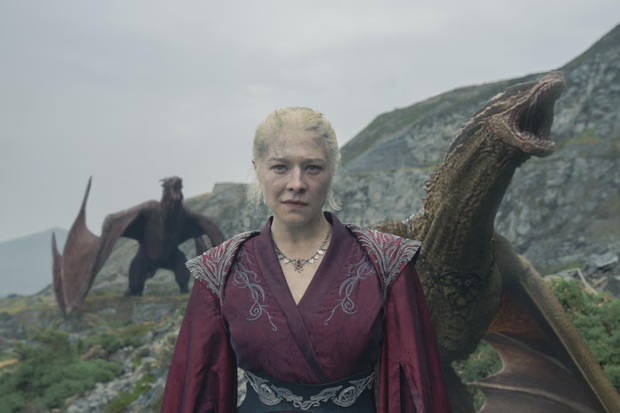
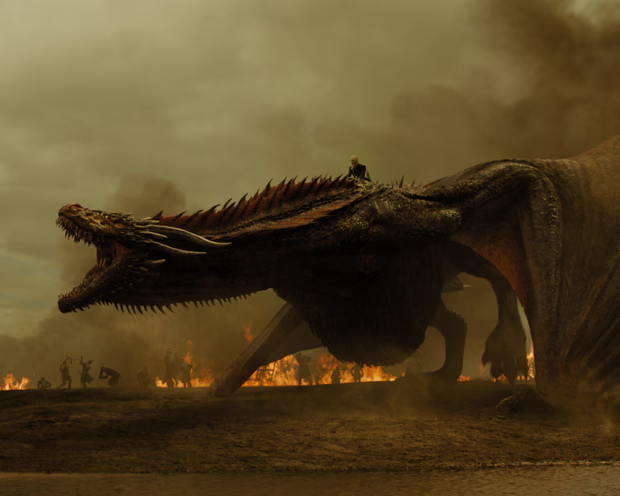
There must be a few Game of Thrones fans out there who have rather mixed feelings about the news that Warner Bros is to bring George RR Martin’s A Song of Ice and Fire “universe” to the big screen. On the one hand, the prospect of a properly enormous fantasy epic featuring dragons the size of commuter trains is undeniably appealing; on the other, have they really thought this thing through?
Reports suggest that the feature film will take as its source material Aegon Targaryen’s conquest, which brought the purple-eyed, dragon-riding clan to continental Westeros (and united six of its seven kingdoms) about 300 years before the events of HBO’s Game of Thrones itself. There’s also a TV series happening, which will presumably cover much of the same ground in greater detail. At first glance, this ought to make even the most reluctant fantasy acolyte want to punch the air. After all, Aegon’s conquest is the sort of story cinema was invented for: dragons blotting out the sky, castles melting like cheese toasties under a blowtorch; an entire continent being thrillingly upended by a bunch of platinum-haired dragonlords.
According to Martin himself, in The World of Ice & Fire (2014) and Fire & Blood (2018), the conquest went roughly like this: Aegon arrives from Dragonstone with three dragons and demands that the kings of Westeros submit. When several refuse, he burns their castles and armies until they surrender. And that, at least according to the existing lore, is pretty much that. The interesting thing about the Targaryens in the A Song of Ice and Fire novels is that three centuries of inbreeding and dragon-whispering have apparently turned them into a nest of brittle, giant-lizard-obsessed autocrats who would rather incinerate half the realm than share power with anyone. There isn’t an awful lot in those original texts about what they were like, though we can get a pretty good idea. To all intents and purposes, they sound like the baddies.
Let’s imagine for a second that Star Wars had followed a similar route. The original 1977 movie would have opened in pretty much the same way, with the Empire stormtrooping across the known galaxy while stopping occasionally to blow up the odd planet. But instead of a ragtag crew of brave rebels, elderly space wizards and whiny moisture farmers rallying against impossible odds to blow up the Death Star, Vader and his pals would have moved swiftly to secure total galactic domination thanks to their overwhelming technical and military-industrial superiority.
In A Song of Ice and Fire, the Targaryens don’t triumph because they are plucky underdogs or brilliant strategists. They win because they possess three colossal flying weapons of mass destruction. The moment Aegon turns up with Balerion, Vhagar and Meraxes, the entire geopolitical balance of Westeros shifts. This probably means the film will need to perform some fairly heroic feats of narrative gymnastics. Modern blockbuster audiences generally prefer their protagonists to be plucky underdogs rather than a heavily armed ruling dynasty, so the screenplay will presumably have to find some ingenious way of reframing the conquest as a story of heroism rather than imperial expansion. Perhaps Aegon will be portrayed as a reluctant unifier, sighing heavily as he incinerates yet another medieval stronghold while explaining that he is doing this only for the good of the realm. Maybe one of the defeated Westerosi kings will be quietly reimagined as a cartoon tyrant, thus transforming dragon-assisted conquest into the fantasy equivalent of saintly regime change.
Failing that, there is always the time-honoured Hollywood solution (also see Amazon’s recent Lord of the Rings TV show) of inventing a brand new hero. Perhaps a humble blacksmith’s apprentice who dreams of dragons, or a sceptical courtier who teaches Aegon the true meaning of leadership.
No matter which way it goes, the movie has every chance of being a colossal cinematic spectacle that delivers some of the most eye-popping moments Martin ever dreamed up – but let’s not mess around here, the ending is going to be weird. Because this is essentially going to be a film that asks audiences to do something they are not normally asked to do in a blockbuster: cheer enthusiastically while the evil empire wins.