
EDITOR’S NOTE: Call to Earth is a CNN editorial series committed to reporting on the environmental challenges facing our planet, together with the solutions. Rolex’s Perpetual Planet Initiative has partnered with CNN to drive awareness and education around key sustainability issues and to inspire positive action.
Wind energy is taking off all over again. This time, literally.
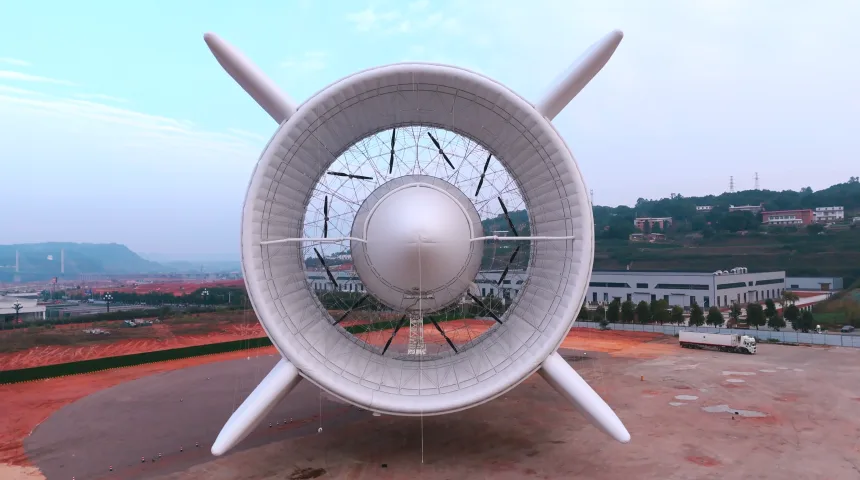
In China, a multi-institute research and development project has created a series of large-scale floating turbine prototypes. The helium-filled aerostats, which send electricity to the ground via a tether cable, can float thousands of feet in the air and have been proposed as a portable, low-impact alternative to conventional wind turbines.
The initiative is spearheaded by Tsinghua University, Beijing, in collaboration with startup Beijing SAWES Energy Technology Co., Ltd. Called Stratospheric Airborne Wind Energy Systems (SAWES), the first prototype debuted in October 2024, and since then, models have increased in size and altitude. The latest model, the SAWES Type S2000, is the first megawatt-class airborne wind power generation system, claims the enterprise, which also goes by the name The SAWES Company.
The S2000 completed a test in January in Yibin, Sichuan Province, floating at 2,000 meters (6,600 feet) and successfully connected to the power grid in a first for the company. During the test the turbine generated 385 kilowatt hours of electricity — enough to power the average US home for roughly 13 days.
The S2000 measures 60 meters (197 feet) long and 40 meters (131 feet) high and wide, featuring 12 turbines with a total power capacity of 3 megawatts, said The SAWES Company. In comparison, the world’s most powerful wind turbine, manufactured by Chinese company Dongfang Electric Corporation, is 340 meters (1,115 feet) high per reports, and boasts a 26-megawatt capacity.

Jianxiao Wang, research associate professor of big data at Peking University, who was involved in the project, said SAWES has multiple environmental advantages over conventional turbines.
“We use up to 90% less material than traditional wind turbines, we do not need massive concrete foundations, or a steel tower (or) disrupt the soil ecosystem,” he said.
“It has very small visual and sonic impact … it is basically silent at ground level and creates a much smaller visual obstruction on the horizon.”
Professor Wang also argued the aerial turbines were easier for birds to avoid compared to traditional wind farms. (Studies estimate wind turbines kill between 140,000 to 679,000 birds a year in the US — notable, though much less than the number killed by power lines, estimated in the tens of millions, and much, much less than the number killed by cats, which could be as high as 4 billion, according to one data review.)
One use case currently in development is on an island in Guangdong Province , south China, where ground space is limited and environmentally protected, precluding conventional wind turbines, he added.
By the end of 2025, 51 patents had been filed, according to the company.
The engineering team has made breakthroughs in material and electrical science, said Wang, using advanced composite fabrics to keep the aerostat lightweight while minimizing helium leakage. SAWES uses atmospheric modelling and AI, enabling it to automatically ascend and descend to find optimal wind speeds. Research suggests this can greatly increase the energy yield compared to harvesting at a fixed height.
Wang Lei, a spokesperson for The SAWES Company, said in the short term, SAWES was “suitable for power supply in remote areas, maybe off-grid energy and emergency power,” including disaster zones, noting the relative ease with which the system could be transported in its deflated state.
Looking further ahead, she believed there were use cases in industrial and infrastructure power supply, adding that the company’s “ultimate goal” is to provide clean energy to the grid, replacing some fossil duel-derived power in the energy mix.

According to the International Energy Agency (IEA), global wind energy growth needs to more than quadruple by 2030 to achieve a net-zero energy scenario. Global capacity is currently on track to nearly double by 2030 to 2,000 GW. China has been a global leader in the sector, adding two thirds of new global wind power capacity in 2023 (the IEA’s most recent year for published data).
Wind energy is abundant, but highly irregularly distributed around the world. Mean wind speed varies, and mean wind power density, the metric used to determine energy potential, varies even more. Factors include location, time of day and geography.
Professor Wang believes that due to SAWES’ high altitude, where wind speeds are stronger and consistent, the system could generate power in more land-based locations than conventional ground-based turbines.
Mark C. Kelly, associate professor at the Department of Wind and Energy Systems at the Technical University of Denmark, said it was difficult to assess this claim.
In an email, he said that peer-reviewed research has shown “various AWE (aerial wind energy systems) can harvest the stronger winds that occur more frequently at distances higher than conventional wind turbines.” He caveated that how wind behaves at heights above 100 meters (328 feet) is “not simple.”
Kelly added that he had not seen peer-reviewed reporting about the SAWES prototype, nor any independently verified data of the SAWES power production at heights beyond 1,000m (3,280 feet). Moreover, he was interested in the basis and validation of the SAWES tether technology, as tether length has proved a limiting factor in existing AWE systems.

Kite-born turbines and crosswind kite power, where the tether movement is linked to a ground generator, have been trialed in the 21st century. Aerostat wind turbines have also been prototyped. California-based Airbine Renewable Energy Systems has been working on a concept for an array of tubular turbines for more than a decade. Altaeros Energies’ BAT (Buoyant Airborne Turbine) was trialed in 2014 and could ascend to 1,000 feet. (Altaeros has since moved on to other aerostat projects that do not involve wind power.) But they have typically been relatively small and produced less power than SAWES.
Rolling out the concept commercially will require conforming to aviation laws and grid regulations in each country.
Airships (including aerostats) are governed by many of the same rules as civil aircraft in the US, including air space restrictions. Special permissions are required to fly above 500 feet, for example, with restrictions around airports and areas with ground visibility less than three miles.
The SAWES project is working to add more communication and monitoring devices to future aerostats, creating what it calls an AeroMatrix.
“We can extend the function from power generation to a multifunctional airship,” said Professor Wang, “including wireless communication, charging services for drones or other electric aircraft. It can even serve as an edge station (localized computing node) for GPU calculations, connecting space satellites, air flights and ground integrating networks.”
The SAWES Company, Peking University, Tsinghua University and the Aerospace Information Research Institute of the Chinese Academy of Sciences have all collaborated on SAWES as part of a National Key Research Project, the funding and details of which the project team said it was not authorized to disclose.
The project is already preparing the next generation of its prototypes, which will be tested later this year at higher altitudes and for longer, with stable power generation, said the company.