Olivia Dean was the big winner at the 2026 Brit awards, taking home awards for artist of the year, pop act, song of the year for her Sam Fender duet Rein Me In, and album of the year for The Art of Loving.
In less than a year, Dean has leaped to the forefront of British pop thanks to The Art of Loving, her second album. With songs that get to the heart of the joys and frustrations of casual modern dating, she is enormously relatable, while her sophisticated and cosmopolitan songcraft, deftly finessing styles such as bossa nova, trip-hop, neo-soul and jazz together, has given her an unusually broad and cross-generational appeal.
The 26-year-old also won one of the “big four” Grammy awards this year, best new artist, underlining her considerable commercial success in the US as well as the UK.
Accepting the award for album of the year, Dean said: “This album is just about love, and loving each other in a world that feels loveless right now.”
Dean won in each of the Brit award categories she was nominated in, and actually triumphed over herself in the song of the year category, having also been nominated for her solo track Man I Need, which has barely been out of the UK Top 10 since its release in August. The song category was voted for by the public via WhatsApp, as was the award for international song of the year, won by Rosé and Bruno Mars for APT.
Rein Me In, a poignant song of love gone asunder, was originally a solo track by Fender included on his album People Watching, before it was released as a single with a new verse from Dean: their version is now top of the UK singles chart. While Dean beat him to the album of the year award, Fender also won the alternative/rock category, his third win in that category after triumphing in 2022 and 2025 (he also won the critics’ choice award in 2019).
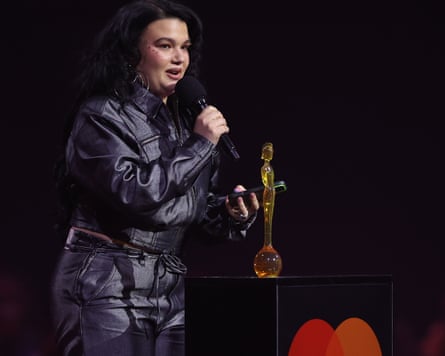
Fender and Dean were the only multiple winners in the ceremony, held for the first time in Manchester at the city’s Co-op Live arena.
Returning host Jack Whitehall kept up his usual high-tempo zingers lampooning various celebrities, calling US singer Alex Warren “what you get if you order Ed Sheeran on Temu”, saying Robbie Williams had “more comebacks than his hairline”, describing Shaun Ryder and Bez as “ageing like service station flowers”, and saying to Manchester mayor Andy Burnham that the Brits was evidently “the only party he’s allowed into these days”. A joke about Peter Mandelson being on the guestlist – “no, sorry, that was another list” – was edited out by ITV from the TV broadcast.
Whitehall even poked fun at another awards ceremony, promising that the Brits had “the guy who did the Baftas” manning the button to silence any swearing on the TV broadcast – a reference to the N-word controversy that dogged British film’s own biggest night last week.
Dean’s main rival was Lola Young, who also received five nominations, but made do with one win for breakthrough artist. That breakthrough has happened in fits and starts over a number of years: Young was nominated for the critics’ choice award back in 2021 and is now on her third album. Her song Messy, released in May 2024, was itself a slow burner, reaching UK No 1 eight months later – meaning that most of the song’s success came in this year’s Brits eligibility period.
Dean’s supremacy also meant there were no awards for Lily Allen, who in another year might have expected to win at least one of her three nominations, given her album West End Girl was critically acclaimed and one of the most talked-about pop cultural phenomena of 2025.
Wolf Alice won group of the year for the second time – they previously triumphed in 2022, thanks to their album The Clearing, an ambitious and sumptuous record anchored by spirited vocals from frontwoman Ellie Rowsell. She dedicated the award in part to the “pubs and clubs and grassroots venues across the country where we quite literally learned to play”, acknowledging the difficulties the sector is facing. She also called for better support for artists, saying that going into the music industry “shouldn’t feel like a golden ticket but a viable career decision”.
Dave won the hip-hop/grime/rap act, the clear favourite after the phenomenal success of his album The Boy Who Played the Harp and its globally popular UK No 1 single Raindance.
Another British rapper, Skepta, shared the dance act prize with producers Fred Again and PlaqueBoyMax thanks to their dubstep-leaning collaboration Victory Lap – it’s Fred Again’s first win in the category after three previous nominations.
After losing to Raye in 2024, the spotlight-shy collective Sault, headed by producer Inflo, won R&B act.
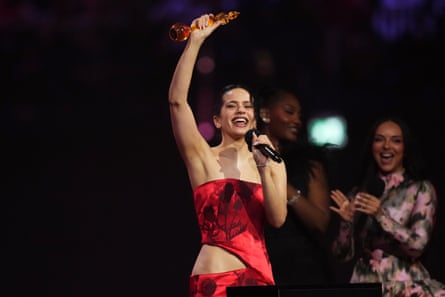
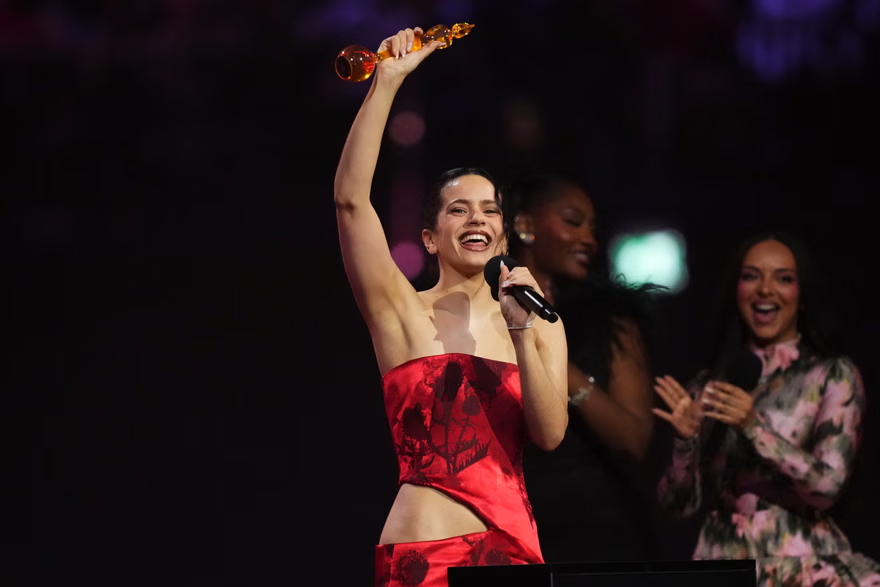
Relative underdogs won each of the other two international categories. Inventive Catalan pop singer Rosalía, whose album Lux was a bold splicing of neo-classical and avant-electronic styles, triumphed over commercial juggernauts such as Taylor Swift, Bad Bunny and Sabrina Carpenter to win international artist.
And defeating arena-filling acts such as Haim and Tame Impala in the international group category was Geese, the young NYC indie rock band whose album Getting Killed blew minds with wise-beyond-their-years lyrics and imaginative arrangements.
The band’s Max Bassin said “free Palestine, fuck ICE” as part of a short acceptance speech, while Scottish singer-songwriter Jacob Alon, winner of the critics’ choice award, held a keffiyeh scarf aloft during an appearance by Sharon Osbourne, who has previously criticised pro-Palestine campaigners.
K-pop was well represented: Rosé’s win for APT makes her the first K-pop award winner in Brit awards history, and the ceremony also had its first K-pop performance, with the flesh-and-blood vocalists of the animated group Huntr/x, from the film KPop Demon Hunters, performing their song Golden in a pre-recorded segment.
A number of award winners had been named prior to the ceremony, including a heartening, history-making first: pop singer PinkPantheress became the first female winner of the producer of the year award, thanks to the spry UK garage-influenced backings she created for her album Fancy That. It’s another impressive milestone for the 24-year-old from Kent, whose star keeps climbing: the remix to her track Stateside, featuring Zara Larsson, is currently the second-most streamed song in the world on Spotify.
Noel Gallagher was named songwriter of the year, following the massive cultural event that was the Oasis reunion. He thanked his brother Liam and his other bandmates, saying: “They brought those songs to life. I’d just be a singer-songwriter and no-one gives a shit about singer-songwriters.”
Mark Ronson was given the outstanding contribution award, recognising a remarkably varied career that has taken him from making hip-hop with the likes of Ghostface Killah, to producing Amy Winehouse’s classic Back to Black, having a global smash with Uptown Funk, making a foray into house as the duo Silk City, and overseeing the successful soundtrack to the Barbie movie. Introduced by Skepta as “the kindest man in music” and “a champion of authenticity”, Ronson paid tribute to Winehouse, saying of his collaborators: “The music I made with Amy is the reason any of them know who I am, that’s why I always treasure her voice, her talent, our bond.” He performed a medley of his hits with guest appearances from Ghostface Killah and Dua Lipa.
Ozzy Osbourne, who died in July 2025, was given a lifetime achievement award, accepted by his wife, Sharon. She hailed him as “authentic, gifted, totally unpredictable, a wild man, a true artist … he was the most humble egomaniac you could ever meet.” The show was rounded out with a tribute performance of No More Tears by Robbie Williams, backed by a band including Metallica’s Robert Trujillo and longtime Ozzy guitarist Zakk Wylde.
One moment that appeared to be controversial turned out to be anything but. US pop singer Sombr was tackled by a man on stage who was taken away by security, but the man was wearing a shirt with the words “Sombr is a homewrecker” on it – a clear stunt to promote the singer’s new single Homewrecker.