He grew up in Ukraine’s industrial heartland. Now it’s a war zone
He grew up in Ukraine’s industrial heartland. Now it’s a war zone
Serhii Korovayny has many warm memories of the Donbas, the region in eastern Ukraine where he spent his childhood.
The photographer remembers picnics and soccer and learning how to swim in the Sea of Azov. As a teenager, he and his friends would spend their days windsurfing and end them by the fire, taking in the sweet smell of the rich grasslands around them.
But today, he says, the smell of feather grass and tarragon has been replaced by the smell of gunpowder. The peaceful air has been infested with drones, and the land has been covered in mines.
The Donbas, long known as Ukraine’s industrial heartland, is now a war zone.


For the past 12 years, Russian President Vladimir Putin has been trying to take control of the Donbas by force.
It all started in 2014, when Russia began backing pro-Russian separatists in the regions, helping them seize parts of Luhansk and Donetsk, the two areas that make up the Donbas. Then came the Russian invasion in 2022.
Today, four years after the invasion began, Russia controls about nearly all of Luhansk and 70% of Donetsk, including Korovayny’s hometown of Khartsyzk.


The photographer doesn’t know if he’ll ever see his hometown again. Or his parents, who still live there with his grandmother.
“My father and my grandma are in their 80s already,” Korovayny said. “The last time I saw both of them was in the coal-mine town of Selydove near Pokrovsk in 2021. As the war wears on, I am afraid I will not see them again. There is a barrier that separates my homeland from my country.”
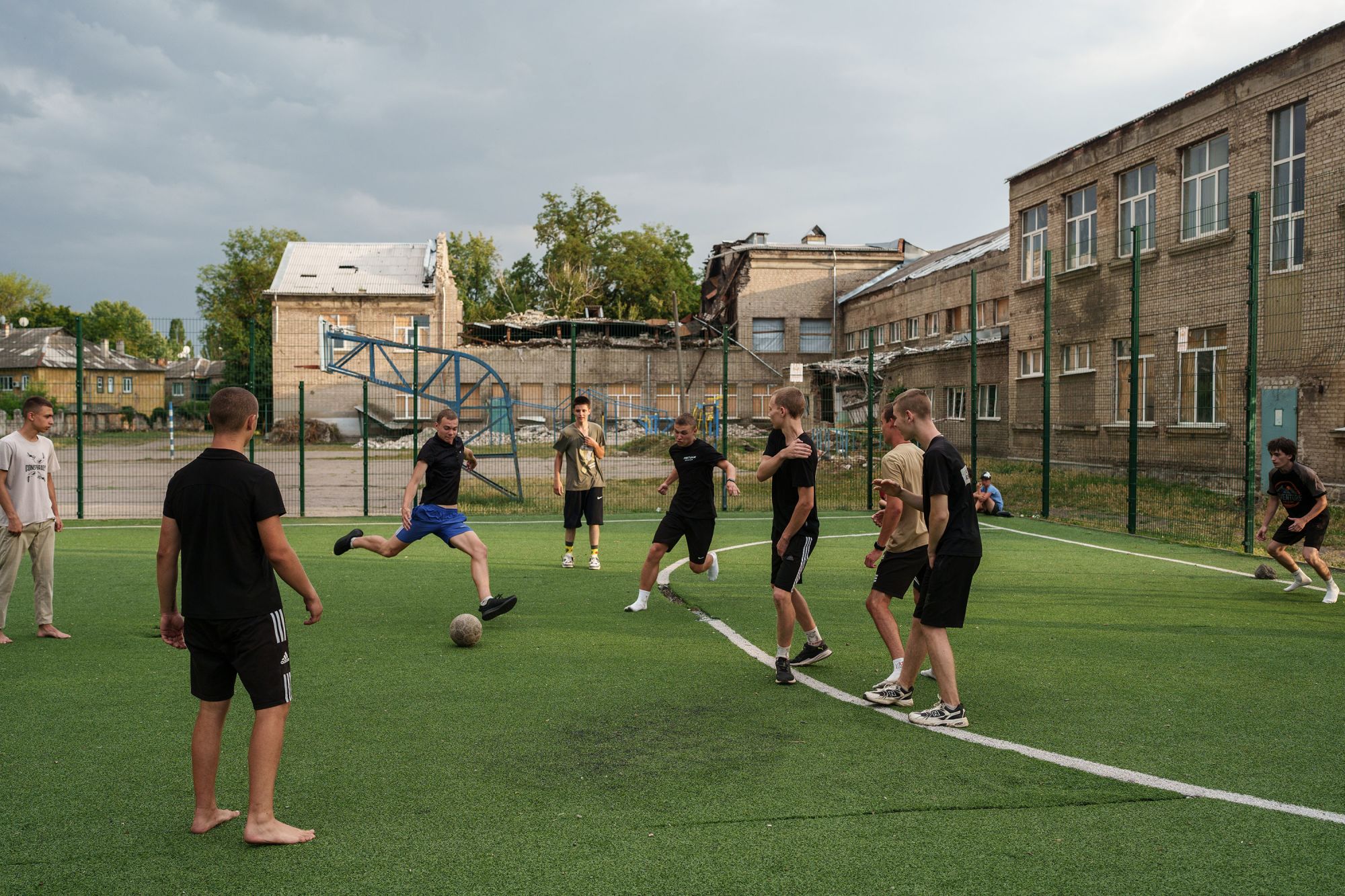
As war ravages the Donbas, Korovayny is determined to tell its story. He has a deep, personal connection to the region and wants to remind the world about its beauty and the people who make it so special.


His photo archive, spanning more than 15 years, fills the pages of his new book “Love Letters to Donbas.” It includes photos both before and after the war, in cities and towns all across the region.
“I cannot stop the advance of the Russian army,” Korovayny says in the book. “What I can do is take pictures. This is my way to preserve memory. Let this book be a naive attempt to resist destruction and oblivion, my love letter to a home region that Russia steals from me.”
The earliest photos in the book reflect some of Korovayny’s core memories as a teenager. Children swimming at a reservoir near Khartsyzk. Driving to Donetsk with his father. Watching his beloved soccer team, Shakhtar Donetsk, play at the Donbas Arena. You see Korovayny’s late grandfather Lev, a massive smile across his face. A model sailboat made by Grandpa Lev hangs on the wall.


Then the book takes a turn, showing how life changed dramatically in 2014, when the pro-Russian proxy forces moved in.
At the time, Korovayny was a college student studying in Kyiv. He would visit home every few months. He vividly remembers what it was like going back in December 2014.
“It was a very unpleasant experience,” he recalled. “Right at the very beginning of the journey, we had to take a bus through a Ukrainian and then a Russian proxies checkpoint. And when I left the Ukrainian checkpoint, when we were driving this no man’s land, I felt anxious.
“I remember this soldier entered the bus and started asking us where we were going and why. I felt very insecure, because these people could do anything with me without any consequences. … And this was the feeling like every day when I was there.”


His hometown was turning into something that he didn’t recognize anymore. “It felt like a trip to another planet,” he says in the book.
When he took pictures of girls dancing as snowflakes during winter celebrations, the focus was less on the girls and more on the “strange men in their mismatched uniforms in the background.” Ukrainian flags had been torn down and replaced by those of the separatists.
Korovayny would still visit home regularly for the next couple of years. But it felt less and less safe each time, he said, and he eventually stopped going.
“May of 2016 was the last time I saw my hometown with my own eyes,” he said.


Nothing from his hometown could prepare him, however, for Russia’s invasion in February 2022.
“It was absolutely the worst day of my life,” he said. “I expected something to happen. But I thought it was going to be in Donbas. I didn’t expect it to be Ukraine-wide.”
He drove his wife and friends to Lviv in the west, spending endless hours in enormous traffic and desperately trying to get gas. He remembers watching columns of Ukrainian tanks and military vehicles heading east, with Ukrainian jets flying overhead. “It gives me goosebumps still,” he said.


Though he was encouraged by Ukraine’s victory in the Battle of Kyiv, the Donbas was hit hard.
“Places like Khartsyzk and Donetsk, which Russia occupied in 2014, remain largely intact,” he said. “Towns contested since 2022, however, were mostly destroyed by the Russian army.”
A few months after the invasion, Korovayny began traveling to the front lines to take pictures. His camera gave him something that many of his fellow Ukrainians didn’t have.
“Many people were lost, and basically I had purpose. I had something to do,” he said. “Photography basically saved me from a mental breakdown, and it’s still saving me every day. I have a mission. I have something to do.”

Every time he gets a free week or two, he jumps into the car and heads to the Donbas — much to the chagrin of his wife, who worries about him.
But Korovayny feels compelled to document what is going on. As a photographer, he believes this is his duty.
Over the past few years, Korovayny has spent time with front-line soldiers who come from all over the country.
“They are all very tired, but they are holding up,” he said. “I’ve never spoken to anyone who says let’s give up. I photograph them and then we just chat and drink tea. They are very open and they all say there is no way we give up or leave now because Russia will continue. It will not be Donbas; it will be our homes next.”


Some of the men in his photos have died in the war. One of them is Pavlo Chernikov, originally from the Lviv region in western Ukraine. Since 2014, he had defended Ukraine in Donbas as part of the 24th Separate Mechanized Brigade. When Russia launched its full-scale invasion, Chernikov was once again on the front line. He was killed in an artillery attack in the Luhansk region in March 2022.
It’s not just soldiers, of course, who are dying in this war.
Korovayny photographed Kateryna Penzeeva at a refugee shelter in 2024 just days after Russian shelling killed her daughter and son-in-law in their yard in the village of Mykhailivka.
“I should have been the one to die,” the elderly woman kept repeating quietly. Her broken arm was wrapped in a cast.


A few days later, the shelter was also bombed by the Russians, Korovayny said. Fortunately, the building was empty at the time.
Korovayny recently spent time in Kramatorsk, one of the few cities in the Donbas still under Ukrainian control.
“People, even living under constant drones and constant mortar and missile attacks, they’re still trying to stay at their apartments, at their homes where they’ve lived for their whole life,” he said. “They tell me: ‘We just buried our grandfather here. We can’t leave it.’ Even though grandfather was killed by a Russian drone. It’s very sad.”


Many of them are already making plans about where to go next if they have to evacuate, he said.
His parents and grandmother no longer have that option.
They chose to stay in Khartsyzk, which is now under Russian control. Their decision wasn’t for political reasons, Korovayny said, but more because of the advanced age of his father and grandmother. They also didn’t want to leave their home.
“It’s basically impossible for them to come here,” Korovayny said. “The whole border is like a front line.”


Korovayny’s father speaks Russian but has lived all his life in Donbas and has a Ukrainian passport.
“We didn’t identify ourselves as Russians,” Korovayny said. “We just didn’t think about politics and identity at all.”
Korovayny grew up speaking Russian but now chooses to stick to Ukrainian unless he’s talking to longtime friends. He says today he cannot stand anything Russian — even the music and literature from his childhood.
“When I hear Russian language — and clearly with like a Russian Moscow accent — I feel anger, and I feel hate,” he said. “And I can’t deal with myself even, knowing that I was a Russian speaker myself for most of my childhood.”

Korovayny said he still occasionally talks to his mother, who is a bit younger than his father and more internet-savvy. But Russia, he said, its blocking many messaging apps, which often makes communication unstable and unreliable.
He worries he may never seen his father or his grandmother again.
“I will never go to any territory controlled by Russia because it’s dangerous and because it’s ugly,” he said “And that’s very concerning because my father is old, my grandmother is old.
“It’s hard for me to say, but they can die any year and I will not be able to go to their funeral. And that really sucks and it makes me very sad.”


Korovayny follows the news closely and, like many Ukrainians, is frustrated at the idea of possibly conceding Donbas to the Russians.
“There are these conversations in so-called peace negotiations: ‘Let’s give up Donbas to Russia, and the war will end.’ … I feel angry about it, because for me, it’s a place of nostalgia, of love, of warm and happy memories.”
He said front-line soldiers and civilians in Donbas are very disappointed, in particular, with the American administration. “They feel betrayed,” he said.


Korovayny thinks the war will end within the next few years. He hopes it is sooner.
“I want been able to live a normal life again,” he said. “We’re talking in winter 2026, with Russia hitting energy infrastructure, and it’s like super cold in my house. It sucks to live in these historical times.”
But when the war does end, Korovayny doesn’t expect to be able to visit the place he once called home.


“For years and years ahead, my hometown and places dear to me will remain under Russian control and will remain in ruins, and I will not be able to go there,” he predicted. “I hope that at least this part of Donbas that we control now will remain under Ukrainian control, and that I’ll be able to go there and take my wife there and show at least how this tiny fracture of my motherland looks like.”
But he will always have his pictures. And his memories — although those are already starting to fade.
“I close my eyes and move around my hometown again and again,” he writes in his book. “But I’m already confusing the streets. The routes overlap. Everything disappears into the darkness.”

Serhii Korovayny’s book “Love Letters to Donbas” was published by FotoEvidence and is now available.