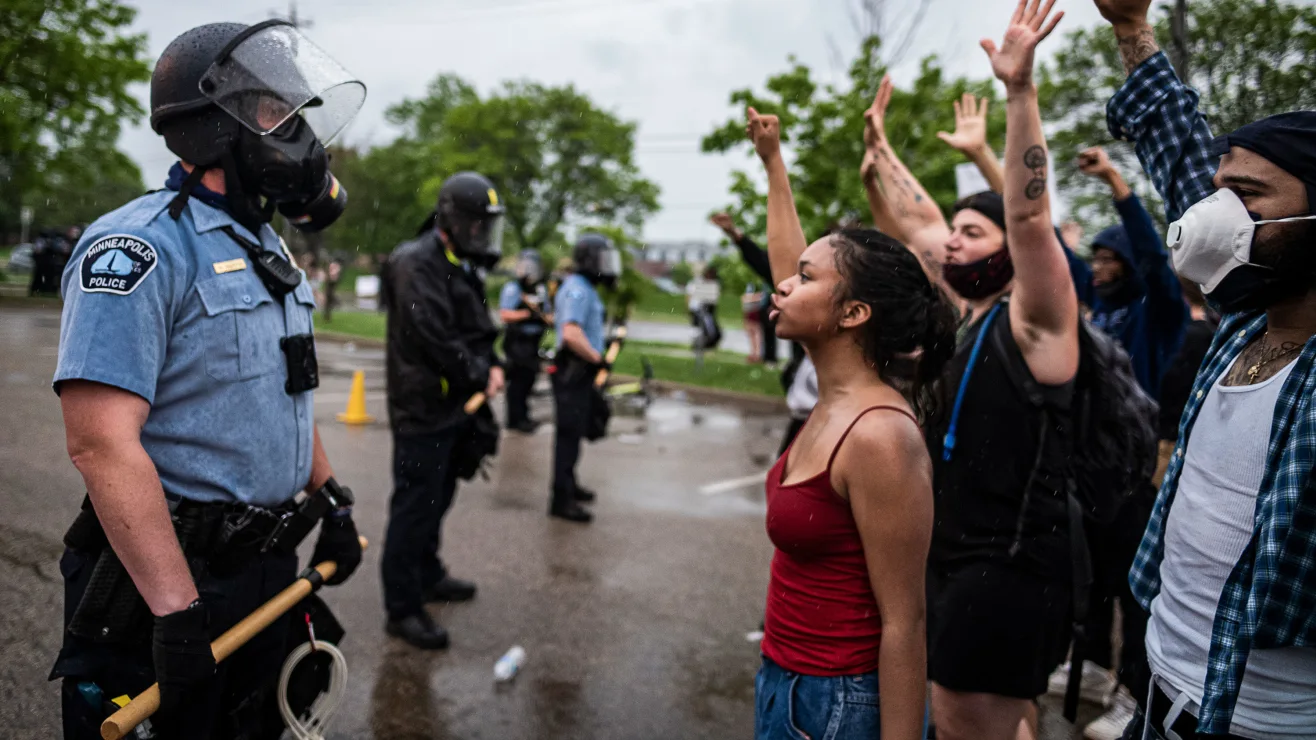

The Black Lives Matter signs that once graced front lawns across America are no longer fashionable. The best-selling anti-racism books gather dust. The armies of protesters that once poured like lava through cities chanting, “I Can’t Breathe” have disappeared.
But keep an eye on Minnesota. What’s been happening there marks the beginning of a new type of racial reckoning. It won’t have the spectacle or lofty expectations of the 2020 George Floyd protests. It could, however, have more staying power.
This claim may sound implausible. Floyd’s murder by a Minneapolis police officer sparked what some have called the largest protest movement in US history. White support for the Black Lives Matter movement reached an all-time high. Elected officials removed Confederate monuments, and former President George W. Bush, a Republican, issued a public statement asking, “How do we end systemic racism in our society?”
That reckoning, though, was more than sweeping protests. Many journalists who covered those protests, including me, defined them as a moment when White people were “forced to confront racism” and face “unpleasant truths.”
That moment failed to live up to expectations. It largely fizzled out in 2021. But some of those same dynamics from 2020 have been present this year in Minneapolis — along with something new. As the Trump administration ends its immigration enforcement surge in Minnesota, the anti-ICE protests there offer an approach for transformational change that blends old and new lessons.
And they’re built on a firmer foundation than the George Floyd protests — for three reasons.
There’s been a racial awakening on immigration
There are obvious links between the Floyd protests and the recent demonstrations in Minnesota. Both were ignited after bystanders recorded videos of citizens dying at the hands of law enforcement. Both took place roughly in the same South Minneapolis neighborhood. Both centered on civic resistance to accusations of law enforcement brutality.
And here’s another common factor: Both forced Americans to confront lessons about racism that had been ignored or forgotten.

President Donald Trump has described his aggressive immigration crackdown as a way to get rid of undocumented immigrants who’ve committed serious crimes, a group administration officials describe as the “worst of the worst.” But the events in Minneapolis have forced many White Americans to confront another possibility: Excluding racial and ethnic minorities is central to President Donald Trump’s immigration policies.
Trump has pushed to end birthright citizenship, the constitutional guarantee of citizenship to any child born on US soil, regardless of their parents’ immigration status — a change that would disproportionately impact people from Asian and Latin American countries.
He’s also banned travel to the US from many majority-Black countries while fast-tracking the resettling of White Afrikaners from South Africa. He recently said, “Somalia stinks and we don’t want them in our country,” but has openly wished more “nice people” would emigrate to the US from Norway, Sweden and Denmark.
The Trump administration says it dispatched federal agents to Minneapolis and St. Paul in part to target allegations of welfare fraud by undocumented Somali immigrants as well as rapists and pedophiles. But its operations have also been accused of sweeping up brown and Black US citizens, along with legal Somalis.
“There is nothing legal that can protect you from White supremacy and the racism that seems to be the compass for this operation,” Danez Smith, a Minneapolis resident who said they have a green card, told CNN last month.

After last month’s fatal shootings of Renee Good and Alex Pretti, there’s evidence that the actions of some federal agents in Minnesota have changed the way many Americans see the immigration crackdown.
Polls show the events in Minneapolis are shifting public opinion against Trump on what was his strongest issue: immigration. No wonder CNN’s Stephen Collinson recently concluded that the administration’s crackdown in Minnesota “has gone far beyond undocumented immigrants” and led to something else: “A national reckoning.”
White martyrs make it ‘everybody’s fight’
The 2020 Floyd protests and the recent ones in Minnesota both grapple with the same question: How do you convert outrage over the death of an American citizen by law enforcement into transformational political change?
George Floyd was too flawed to carry the full weight of that challenge. He was a felon – convicted for his role in a $18 drug deal – who had been imprisoned multiple times. He was a tall, dark and muscular Black man. And he had traces of drugs in his system when he died. For these reasons, some Americans struggled to see his humanity. One prominent conservative called him a “scumbag.”
But Pretti and Good, the two Minneapolis residents killed by federal agents, are more sympathetic figures because of another unpleasant truth about racism: Black lives may matter, but when it comes to eliciting sympathy for a protest movement: White lives matter more.
“What makes Good’s killing unique is that she was a blonde, white woman and a U.S. citizen. It’s Good’s whiteness and her American citizenship that has made her so dangerous to the Trump administration,” Adrian Carrasquillo wrote in The Bulwark, a news media outlet.
Pretti, meanwhile, was a White ICU nurse who worked with veterans and was legally carrying a holstered gun when he was killed.

Many White people have family and friends who look like both victims, and their deaths affect White America in a way that Floyd’s never could.
We’ve seen this dynamic before. It’s what shaped one of the civil rights movement’s most bittersweet victories.
The Selma, Alabama, campaign of 1965 is primarily known today for the Edmund Pettus Bridge march, when future US congressman John Lewis and other Black civil rights activists were clubbed and tear-gassed by Alabama state troopers while attempting to march for equal voting rights.
But the murders of two White people in Selma also galvanized support for that campaign. Viola Liuzzo was a Detroit housewife who was killed after traveling to Alabama to help demonstrators. Like Good, she was shot to death while driving a car. She was also falsely smeared by federal officials — not as a “domestic terrorist” like Good, but as a drug addict and promiscuous woman. Liuzzo’s murder helped reframe the civil rights movement as “everybody’s fight”— the rationale she gave her children before taking her ill-fated trip to Selma.
The Rev. James Reeb was a young father who was clubbed to death by White segregationists while walking through Selma one night. President Lyndon Johnson went on national television and praised Reeb as “a good man – a man of God” while urging Congress to pass the Voting Rights Act, which it did.

More people today know about Reeb and Liuzzo than another activist, Jimmie Lee Jackson. He was murdered near Selma while protesting for voting rights. His death, though, never got the same attention. He was Black.
‘Clicktivism’ can’t replace community
In the summer of 2016, leshia Evans gave the Black Lives Matter campaign one of its most powerful images.
She traveled from Pennsylvania to Baton Rouge, Louisiana, to protest the death by police of Alton Sterling, a Black man, and confronted police in the street. A news photographer captured an image of Evans facing a phalanx of helmeted police in riot gear. As they swarmed her, brandishing zip ties, she stood as still and tranquil as a statue of Buddha — staring resolutely ahead as her dress billowed in the wind.
The photograph became a rallying cry for racial justice protesters. It surfaced repeatedly on social media accounts and underscored the power of a single image to help send millions of Americans into the streets.
But it didn’t create something else that a social justice movement needs to sustain itself: community. In 2026, more Americans are aware of the limits of “clicktivism” — political protests driven by social media and carried out largely online.

The Floyd protests depended too much on the power of images to produce transformational change. Its leaders did talk about passing laws and changing policy. But the spectacle of those 2020 street protests wasn’t followed by a strong second act.
“Clicktivism is to activism as McDonalds is to a slow-cooked meal,” Micah Bornfree, co-creator of the short-lived Occupy Wall Street movement of 2011, once said. “It may look like food, but the life-giving nutrients are long gone.”
There were, of course, other reasons for the failures of the 2020 protests. Despite campaign promises by Joe Biden to address racial justice issues as president, Congress failed to reach an agreement on a proposed police-reform bill. Conservative activists engineered a critical race theory backlash that censured discussion of race in schools. In addition, Black Lives Matter’s credibility eroded after some of its leaders were accused of corruption and misusing donor funds.
Those nutrients for durable activism, though, are abundant in Minneapolis. Residents are trained and organized, and they’ve formed coalitions and built mutual aid networks. They are tracking ICE operations, filming federal officers in the streets with their phones and bringing food to immigrant families in hiding.
Those strong community ties often take years to build. The summer of 2020, with its Covid lockdowns, didn’t allow people to safely be physically present with allies. But the Minnesota protests, where the civic unity is as palpable as the biting cold, stand on more solid ground.
“The past couple of months… have shown that huge numbers of Americans do love their neighbors—enough to show up on frozen streets to confront federal agents, and even risk death,” Julie Beck wrote in The Atlantic. “The response to Border Patrol and ICE’s presence in Minnesota has prompted one of the greatest mass displays of neighborly love that I’ve seen in my lifetime.”
That kind of neighborly love crosses racial boundaries. It’s the type of love that made the Rev. James Zwerg a White hero of the civil rights movement. Zwerg was rejected by his family for joining Black civil rights activists in the early 1960s. He was almost murdered by a White mob in Alabama while protesting with John Lewis. Yet Zwerg continued to participate in the movement. He said he couldn’t have done so without the physical presence of his friends.

“Each of us was stronger because of those we were with,” Zwerg said. “If I was being beaten, I knew I wasn’t alone. I could endure more because I knew everybody there was giving me their strength. Even as someone else was being beaten, I would give them my strength.”
Protests are spreading beyond Minnesota
Will the reckoning in Minnesota spread to other parts of the country? There are signs that it already has.
The Minnesota protests are part of a growing movement that has also mounted fierce resistance in Chicago and Los Angeles. Parents, teachers, clergy members and community organizers in other cities are seeking training for what they can legally do when witnessing an immigration arrest. In Los Angeles and Chicago there are reports that ICE resistance has reached block clubs, neighborhood group chats, and Catholic parishes not typically aligned with the Democratic party.
Anti-ICE protests also have also spread to red states. In Springfield, Ohio, a network of Black, White and Latino churches called G92 has formed to protect the Haitian community.
The organizers of last year’s “No Kings” protests recently announced they will hold demonstrations nationwide March 28 to protest the Trump’s administration’s immigration crackdown, saying, “Black and brown communities are being terrorized” in Minnesota.

What’s happening in Minneapolis and across America this year will likely follow a different script than in 2020. But the needle won’t move unless Americans face some hard truths about race and ethnicity and what kind of country they want to live in.
Will there be demonstrations as large as those in the summer of 2020? Will protests be propelled by dramatic gestures shared online, such as police chiefs and corporate CEOs taking a knee for racial justice?
Probably not. And maybe that’s ok. Those #BlackLivesMatter optics turned out to largely be a sugar high. They led to some local and state reforms, but they didn’t give the Floyd protest movement the “life-giving nutrients” it needed to survive.
Those ingredients are present in Minnesota. What’s happening there has led to a “lasting shift in public opinion” on Trump’s handling of immigration.
Americans also are savvier today about what elements are needed for true change. Not all transformational change announces itself with viral images and dramatic clashes in the streets. The widespread acceptance of gay marriage, for example, was driven in part by everyday people quietly coming out to family, friends and co-workers.

Immigration will remain a complex issue. Most Americans want secure borders. And the country’s racial divisions are deeper than those in 2020. Even the Super Bowl, America’s premier sporting spectacle, can’t escape fierce debates over racial and ethnic identity.
But look deeper at what’s happening across the country, and you can dare say something that would have been unimaginable just a few months ago:
America is on the verge of a new type of racial reckoning.