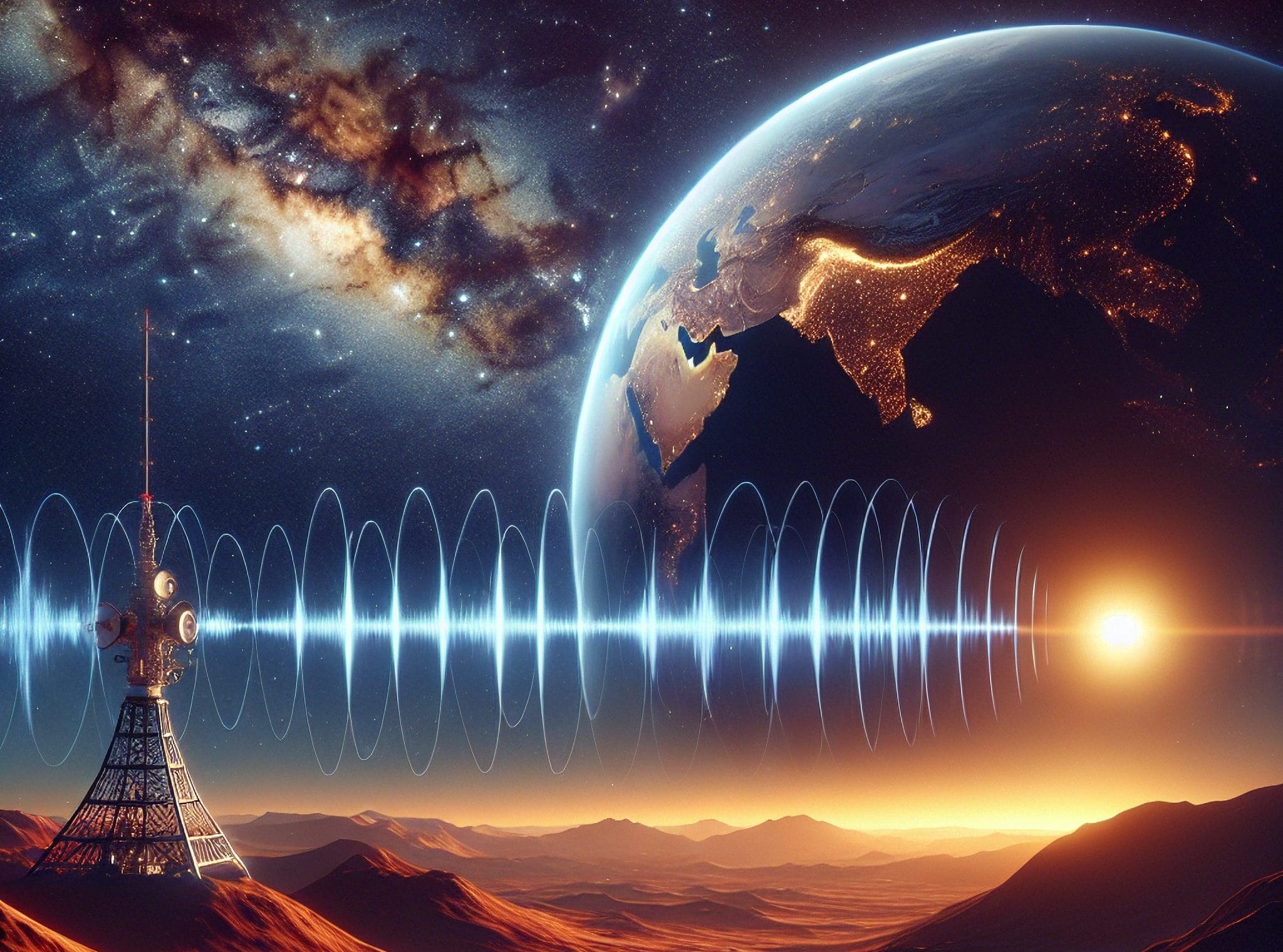
Earth’s leading alien hunters believe extraterrestrials could be out there, they’re just having a hard time getting through to us because it’s stormy in space.
Reminiscent of ET’s struggles to “phone home” in Steven Spielberg’s 1982 blockbuster movie, new research by the Silicon Valley-based SETI Institute (search for extraterrestrial intelligence) suggests tempestuous space weather makes radio signals from the distant cosmos harder to detect.
The organization, which is partly funded by Nasa, said stellar activity such as solar storms and plasma turbulence from a star near “a transmitting planet” can broaden otherwise ultra-narrow signals. That spreads the power of any such transmission across more frequencies, the institute’s scientists say, which makes it more difficult to detect using traditional narrowband searches.
“If a signal gets broadened by its own star’s environment, it can slip below our detection thresholds, even if it’s there, potentially helping explain some of the radio silence we’ve seen in technosignature searches,” SETI astronomer Vishal Gajjar said.
His report, co-authored with SETI research assistant Grayce C Brown, was published this week in the Astrophysical Journal.
For decades, SETI and other researchers have listened to the heavens for signs of non-human life by trying to identify spikes in frequency, indicating signals it said were unlikely to be produced by natural astrophysical processes.
The new research, they say, highlights an “overlooked complication”: even if an extraterrestrial transmitter produces a perfectly narrow signal, it may not remain narrow by the time it leaves its home system.
“Plasma density fluctuations in stellar winds, as well as occasional eruptive events such as coronal mass ejections, can distort radio waves near their point of origin, effectively ‘smearing’ the signal’s frequency and reducing the peak strength that search pipelines rely on,” a statement accompanying the finding states.
In layman’s terms it means that, however unlikely a scenario, the institute believes aliens might be out there, and could be trying to talk to us. But if they are, unpredictable weather conditions have garbled the messages, and we simply cannot hear them.
The SETI team made the discovery by calibrating the effects of stellar activity using radio transmissions from spacecraft in our own solar system, then extrapolating them to the environments of faraway stars.
Brown said the findings meant space listeners would have to rethink the long-established mechanics of the search for alien lifeforms, including conducting future observation surveys at higher frequencies.
“By quantifying how stellar activity can reshape narrowband signals, we can design searches that are better matched to what actually arrives at Earth, not just what might be transmitted,” she said.
Whether humans are alone in the universe has been one of mankind’s enduring mysteries, while the possible existence of UFOs, unidentified flying objects now referred to as unexplained anomalous phenomena (UAP), has sparked numerous conspiracy theories and countless movies of varying quality.
In 2024, a former defense department official made the startling but unsubstantiated claim to Congress that government employees had been injured during encounters with aliens.
That came a year after whistleblower David Grusch, a former intelligence official who led a government team analyzing UAP until 2023, insisted the Pentagon had run a secret decades-long program collecting and attempting to reverse-engineer crashed UFOs.
Tim Burchett, a Tennessee Republican congressman and co-chair of the House panel looking into UAP, immediately downplayed Grusch’s claim. “We’re not bringing little green men or flying saucers into the hearing, sorry to disappoint about half y’all,” he said.
Burchett had previously claimed the US had evidence of technology that “defies all of our laws of physics”, and that alien craft possessed technology that could “turn us into a charcoal briquette”.
A 2024 government report showed that more than 750 new UAP sightings were reported between May 2023 and June the following year.
Barack Obama reignited the debate last month when he claimed on a podcast that aliens “were real”, then hastily backtracked in a social media post the following day to assert he had seen no evidence of them, and was caught up in the exuberance of an interviewer’s questions.
The episode prompted Donald Trump to announce he was authorizing the release of all government records on aliens, UFOs and UAP. “I may get him out of trouble by declassifying,” the president said of Obama, whom he has frequently disparaged.
“I don’t know if they’re real or not,” Trump told a gaggle of reporters on Air Force One.