FBI FILES: THE STRANGE CASE OF OTIS T. CARR AND THE “FREE ENERGY” SPACECRAFT
FBI FILES: THE STRANGE CASE OF OTIS T. CARR AND THE “FREE ENERGY” SPACECRAFT
A Declassified File Reveals Government Interest in a Controversial Inventor
Recently released documents from the U.S. Federal Bureau of Investigation (FBI) provide a glimpse into the unusual story of Otis T. Carr, a mid-20th-century inventor who claimed to be developing revolutionary technology capable of powering spacecraft using “free space energy.”
The documents were released in December 2020 under the Freedom of Information Act (FOIA) after a request by researcher John Greenewald Jr., founder of the online archive The Black Vault. According to the FBI’s response, 60 pages of records were reviewed and released related to Carr and his company, OTC Enterprises.
An Inventor Claiming Energy from Space
In a memorandum dated March 4, 1958, the FBI recorded information about Carr and his Baltimore-based company OTC Enterprises Incorporated.
The information came from Edward W. Hull, associate editor of the magazine Missiles and Rockets. Hull reported that Carr’s company claimed to have developed a device capable of:
“picking up and utilizing free space energy, such as light.”
According to Hull, such a device would be revolutionary for rocket technology because it could potentially solve the fuel problem by allowing spacecraft to draw energy directly from the surrounding space during flight.
If the technology worked as described, rockets could theoretically operate without conventional fuel.
Claims of Spacecraft and Moon Missions
Promotional material associated with Carr’s company painted an even more ambitious picture.
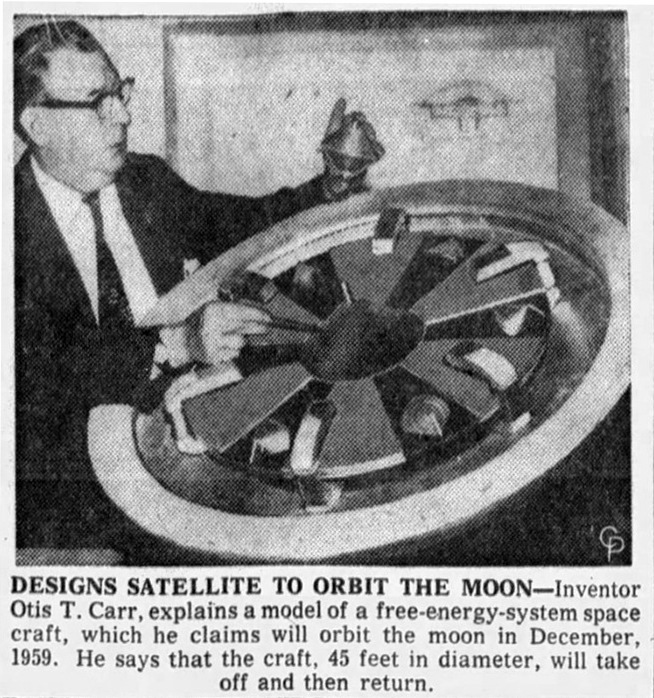
Letters circulated by OTC Enterprises claimed that Carr was preparing to launch a 10-foot demonstration spacecraft capable of traveling into space, returning, and even entering orbit around the Earth.
The documents further described plans for a 45-foot spacecraft intended for a future trip to the Moon, with Carr and an associate reportedly planning to make the journey themselves.
These extraordinary claims were part of a broader effort to attract investors and public interest in Carr’s technology.
Concerns About the Company
The FBI files also show that authorities received information questioning the legitimacy of the enterprise.
A woman considering employment with OTC Enterprises told investigators that the company appeared to be soliciting investments and selling stock, while promoting inventions such as a “Free Energy Mechanism” and a “Gravity Motor.”
She also reported that Carr claimed he could have launched a satellite into space two years earlier if he had received sufficient financial backing.
The bureau documented these statements but did not conclude that any of the technologies actually worked.
Associates and Background Checks
The investigation also mentioned Norman Evans Colton, a director and sales engineer at the company.
Records indicated that Colton had previously been investigated in unrelated cases involving impersonation and alleged fraud, although prosecutions in those matters were ultimately declined.
Authorities noted that Colton had once been employed at the Aberdeen Proving Ground before being dismissed.
Skepticism From Observers
Not everyone believed Carr’s claims.
One researcher who contacted the FBI described OTC Enterprises as “one of the most flagrant” money-gathering organizations promoting questionable UFO-related ideas, arguing that if the technology were genuine it would likely already be used by the U.S. military.
Internal FBI correspondence also suggested the technology lacked scientific value, though officials noted that the story could still attract public attention or even foreign intelligence interest.
A Curious Chapter in UFO-Era History
The Carr file illustrates how unconventional aerospace claims during the 1950s “flying saucer era” occasionally reached the attention of federal authorities.
While the documents do not confirm the existence of any working “free energy” spacecraft, they provide a fascinating look at how bold technological claims, investment schemes, and Cold War anxieties intersected during the early days of the Space Age.
Today, the declassified records stand as an unusual historical snapshot—showing how one inventor’s extraordinary ideas briefly captured the attention of both the public and the FBI.