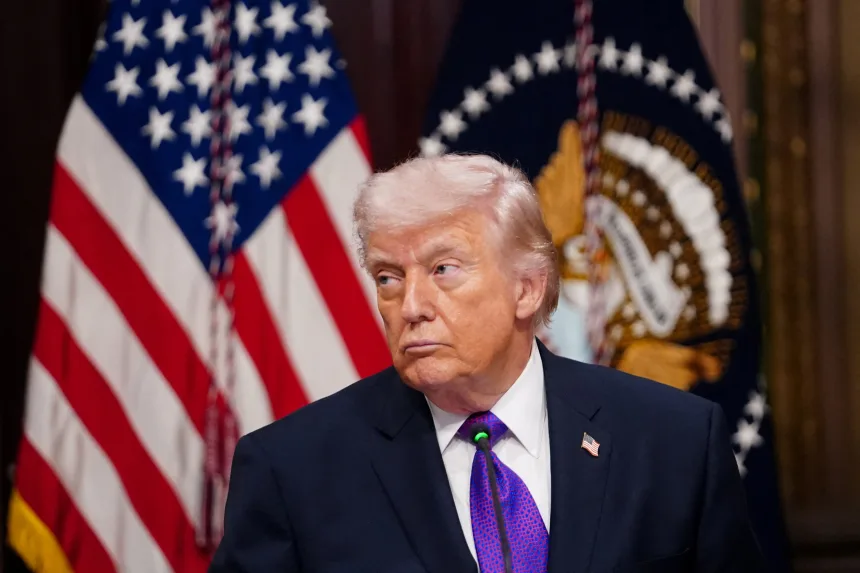

US President Donald Trump’s demand that he help select the new supreme leader of Iran provides perhaps the clearest insight yet of how close a conclusion might be. On the surface, it appears wildly fanciful, almost absurd, to think that the 88 senior Iranian clerics charged with replacing the theocrat at the top of an Islamic Republic founded to resist American influence would take their cue from, or heed, the White House. But Trump’s demand, and his rejection of late Ayatollah Ali Khamenei’s son, Mojtaba as his successor, reveals two important points.
First, that Trump thinks the Venezuela model can work here – of military action forcing a regime to change, rather than forcing regime change. But Iran is a hardline, aggressive, heavily-armed autocracy that has been wreaking havoc across the Gulf for a week, and that killed thousands of its own people just a few weeks ago. It is not as simple as ousted Venezuelan President Nicolas Maduro’s oil kleptocracy. Yet Trump’s aspirations betray where the US might think its war is headed.
Secondly, the remark hints at political compromise. Masoud Pezeshkian, Iran’s moderate-ish president, hinted at mediation efforts Friday morning. On Wednesday, Iran’s foreign minister called Qatar and France. Hours later, more Iranian missiles hit Doha, suggesting at the least differing approaches inside Tehran. Trump said Thursday Iran wanted to talk, but the US wanted to fight more than they did. His demand Friday for an “unconditional surrender” arguably reinforces the idea that Trump is angling for a resolution rather than the militarily-imposed collapse of Tehran’s regime.
A new Iranian leader might provide a clean chance to strike a deal. Some kind of political compromise does still appear to be the most likely off-ramp. Trump’s remarkable bravado – amplified by his Defense Secretary Pete Hegseth – seems designed to generate peak leverage. Trump did again evoke Thursday the idea of an Iranian uprising, but it has yet to become part of a set of concrete US aims that CENTCOM appears, day by day, to be nearing. A near 90 per cent drop in missile and drone launches by Iran, and over 30 sunken Iranian naval ships, according to a Thursday CENTCOM statement, would suggest two of the US military goals are close.

The week-long delay in appointing a successor to Khamenei is becoming conspicuous. A succession plan was widely publicized ahead of his death, and infighting, coupled with a fear of how long any successor might survive Israel’s pledge to kill them, might be slowing the announcement.
But the failure to fill this leadership vacuum is perhaps the first unintended consequence of the war. The US might be okay with not knowing who is in charge as they start a war, less so as they wonder how long it may last. A week in, the void provides both chaos and opportunity. Iran continues to try to project strength. Its missiles and drones are less effective and frequent than before, but it is still launching them to signal it is not down.
Trump spoke Thursday of a military campaign ahead of schedule, and the need for a new supreme leader who is aligned enough that the US does not need to attack again in 10 years. It is an approach more in keeping with his instincts for deals and for swift and unexpected military action. Yet in a war of this scale, plans and aspirations rapidly deteriorate. There are already two obvious wild cards.
Israel is moving its offensive against the much-reduced Lebanese militant group Hezbollah at a remarkably aggressive pace, ordering vast evacuations within about 72 hours of announcing a campaign. Israel’s ambition to “disarm” its long-term foe could devolve into months of ground warfare, or swiftly return to the past year of aircraft picking off targets daily when they arise. Israel’s campaign to its north did not seem to have been part of the US’ initial public strategy. It should perhaps be seen as separate from America’s conflict with Iran, but it is a competing dynamic that means Israel may be less keen on a regional ceasefire.
Iran’s furious and persistent bids to hit Gulf states – lasting the full first week – show the potential for Iranian military hardliners to insist the US and its allies blink first. This is an existential war for the Iranian regime, and public weakness would fatally compound the practical weakness Israeli and US bombing has imposed. Without a respected and established Iranian leader to rein the drone army in, these attacks – even if they are often intercepted – could upset any chance of an off-ramp. Iran may soon run out of drones, yet has other asymmetrical options – such as choking the Strait of Hormuz or plotting terror on foreign soil – that can irritate the US and disrupt peace. That it will eventually be forced to stop is less of a given.
The pace of this campaign is unprecedented, upending most norms of warfare and its old timelines. AI-fueled target lists, and the US’s wild technological air superiority has achieved in a week what 23 years ago might have taken months. But entropy remains the same. Weeks before the invasion of Iraq in 2003, US Defense Secretary Donald Rumsfeld said the war “could last six days, six weeks. I doubt six months.” The first phase of US occupation was launched in the belief that the Iraqi people would rise up and reject their oppressors. Instead, much of Iraq rose up to expel US ground forces, and the war dragged on for eight years.
This is a different war, in an era where the moral high ground is less urgently occupied, and gamer-themed bravado on social media has nudged aside horror at the savagery of warfare. You can bet on few things other than the pressure economic upheaval will put on Trump as the war extends.
This week has set new speed records for conflict and destruction. As it draws to a close, the need for age-old diplomatic solutions persists. By next Friday, they may appear less in reach.