Police in Canada have concluded that a missing Iranian activist was most likely the victim of murder, prompting fears that his disappearance has the hallmarks of a transnational repression campaign targeting critics of Tehran.
Masood Masjoody, a mathematician critical of both Iran’s theocratic regime and the exiled family of the former shah, went missing in early February in the city of Burnaby, British Columbia.
Police are still searching for Masjoody’s body, and a spokesperson for the integrated homicide investigations team, which is part of the Royal Canadian Mounted Police (RCMP), said all of the evidence investigators have collected indicates foul play.
“We are treating this as a homicide,” Sgt Freda Fong said.
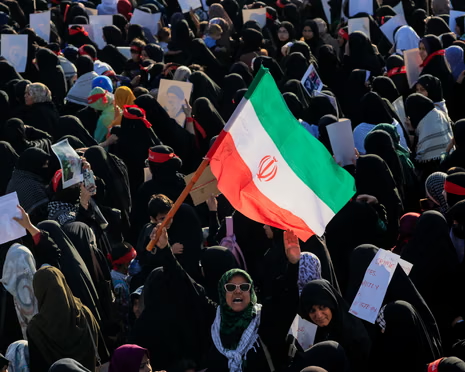
Activists who have documented Iran’s recent deadly crackdown on protesters fear the disappearance reflects a policy of attempting to silence members of the diaspora community who are critical of the Iran’s theocracy.
“[Masood] has been very vocal against not only opposition groups, but also the regime,” said Tadayon Tahmasbi, an Iranian based in the Netherlands. Tahmasbi, who survived an attempt on his life in June 2024 believed to be linked to Iran’s Islamic Revolutionary Guard Corps (IRGC), said the regime in Tehran is working “to stifle and silence voices abroad more than it ever did before”.
“I can only hope the truth of his disappearance and those behind it are caught. For now, we across the diaspora are very worried for Masood,” he added.
Masjoody obtained his doctorate in mathematics from Simon Fraser University in Burnaby, specializing in discrete mathematics and graph theory. He was hired as a sessional instructor that same year and taught mostly undergraduate courses, including one on analytical and quantitative reasoning.
But Masjoody sparred with the mathematics department, including a clash over his “alternative grading system” and his class assignments. He also faced allegations of sexual harassment and made repeated misogynistic and violent posts on social media targeting female colleagues. He was terminated for “just and reasonable cause” in 2020.
His subsequent 2021 lawsuit against the university and colleagues, which he lost, alleged a “conspiracy, weaponizing my personal life against me, defamation, and wide-spread cover-up” in part enabled by “malicious efforts on behalf of Khamenei’s regime”. But he also warned Canadian authorities about what he believed was Iran’s “alarming infiltration” of postsecondary institutions in the country – including at Simon Fraser University.
In a letter to then prime minister Justin Trudeau, Masjoody said he had flagged Iranian regime programs that were involved in sensitive engineering and technology fields and warned that technologies developed in Canada could be brought back to Iran for nefarious purposes.
He also sued a local news outlet, the social media company X and members of the Iranian community. But last year, BC’s court of appeal barred Masjoody from initiating or continuing any appeals without its permission, citing a years-long pattern of “habitual, persistent, and without reasonable cause” litigation.
A judge found that Masjoody’s suits had escalated, including instances in which he alleged Simon Fraser University administrators were enabling “spies from the Islamic Republic of Iran” and called one judge “reprehensible”, “inhumane” and “barbarically biased”.
Sgt Fong said most of the tips provided to police have come from the Iranian community, but she said that unless they find a body, it can be “very difficult” to bring any criminal charges.
Police have provided little information about the scope of the investigation or if they have suspects.
“Any speculation over whether Iran was involved would be premature and compromise the integrity of the investigation,” said Fong, adding it was “understandable” that activists and members of the public considered it a possibility.
“Masood was very vocal about his views and didn’t shy away from telling the world about it,” said US-based Alborz Pakravan, an exiled Iranian economist who worked with Masjoody in activist circles. “In the aftermath of the massacre [of protesters] in Iran, I am afraid this is a part of the revenge campaign led by the Islamic Republic against dissidents abroad. It’s impossible to not speculate that someone this vocal was a problem and it points to the regime weaponising transnational repression to silence us.”
In addition to warnings from Canada’s intelligence agency over foreign interference from Iran, a 2024 report from the France-based Global Initiative Against Transnational Organized Crime found that Iran relied on “clusters of foreign currency exchange brokers” to launder funds and finance terrorist proxies, including “nodes” in large Canadian cities like Toronto and Vancouver.
That same year, Iran is believed to have targeted prominent critics within Canada. In November 2024, former Canadian justice minister Irwin Cotler said he had been the target of an alleged Iranian assassination plot. The RCMP warned Cotler, a fierce critic of Iran’s government, of an “imminent assassination attempt within the next 48 hours”.
Cotler had drawn the ire of Iran’s clerics for his campaign to list the IRGC as a terrorist entity, which Canada did in 2024.
“In particularly alarming cases over the last year, we’ve had to reprioritise our operations to counter the actions of Iranian intelligence services and their proxies who have targeted individuals they perceive as threats to their regime,” the head of Canada’s spy agency, Dan Rogers, said in November. “In more than one case, this involved detecting, investigating and disrupting potentially lethal threats against individuals in Canada.”
Pakravan said that Masjoody’s disappearance “has brought to light the consequences of speaking openly” against Tehran, adding that governments must “take seriously how dangerous this regime has been”.