Paleontologists Discovered a New 40-Foot-Long Dino Species. They Call It the ‘Hell Heron.’
Paleontologists Discovered a New 40-Foot-Long Dino Species. They Call It the ‘Hell Heron.’
Here’s what you’ll learn when you read this story:
- Dinosaur hunters scouring a fossil field in the middle of the Sahara Desert uncovered a second species of Spinosaurus.
- The scimitar-crested Spinosaurus mirabilis, replete with fish-trapping jaws, is huge, measuring the length of a school bus.
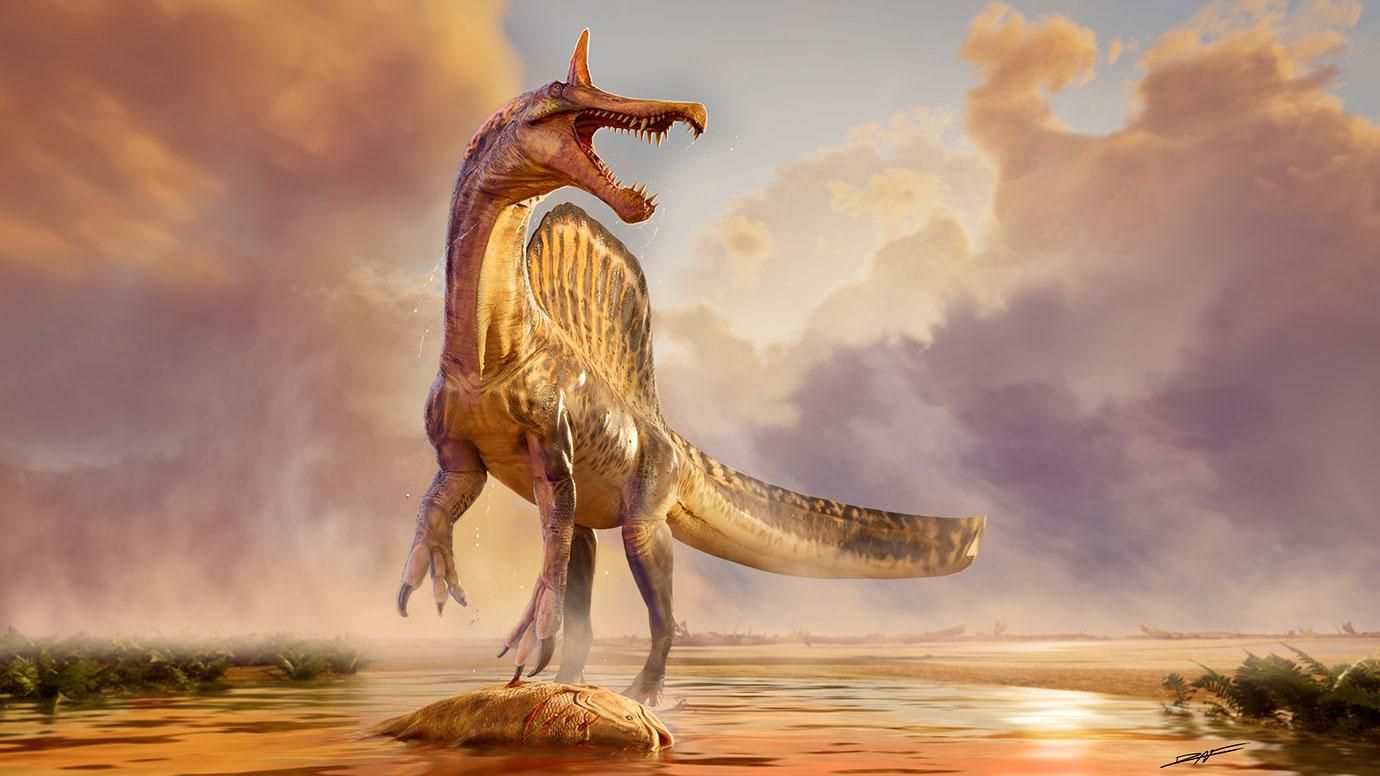
- Researchers said the prominent skull was probably highly colorful and a key mate-attracting element of the “hell heron.”
Researchers working in the central Sahara Desert have unearthed stunning fossilized remains of a previously-unknown dinosaur—and it’s not your run-of-the-mill dinosaur. This newly discovered species was as long as a school bus, wielded a trap-like jaw to snatch up the largest fish prehistoric Africa had to offer, and sported a wildly colorful scimitar-crest on its skull.
The new dinosaur is named Spinosaurus mirabilis and it’s only the second Spinosaurus species ever found. It makes the star of Jurassic Park III—Spinosaurus aegyptiacus—look a little less impressive by comparison.
The find was so unexpected that researchers didn’t even realize quite what it was for several years. According to research published in Science, a team led by paleontologist Paul Sereno of the University of Chicago took a single line a French geologist wrote in the 1950s about a possible fossil field and turned it into a hunt. A local Tuareg man led Sereno’s team on motorbikes deep into the Sahara, where he’d once seen fossilized bones. The team then found the teeth and jaw bones of the new Spinosaurus species in Jenguebi, a fossil bed rich in dinosaur remains.
“This find was so sudden and amazing, it was really emotional for our team,” Sereno said in a statement. “I’ll forever cherish the moment in camp when we crowded around a laptop to look at the new species for the first time, after one member of our team generated 3D digital models of the bones we found to assemble the skull—on solar power in the middle of the Sahara. That’s when the significance of the discovery really registered.”
The scimitar-shaped crest of the S. mirabilis was so large, scientists didn’t immediately understand what it was when they found it in 2019. Three years later the scientists returned and found two more crests. That’s when they fully pieced together the 40-foot-long find.
“No one had been back to that tooth site in over 70 years,” Sereno said. “It was an adventure and a half wandering into the sand seas to search for this locale and then find an even more remote fossil area with the new species.”
This sail-backed, fish-eating giant from Africa likely weighed several tons, but there’s more to the new Spinosaurus than just heft. The curved, bony crest on its head was likely brightly colored, the team wrote—a way to attract mates. Within the jaw, the S. mirabilis had interdigitating upper and lower teeth (meaning the teeth of the lower jaw protrude outward and in-between the teeth of the upper jaw), making it a deadly trap for slippery fish.
According to a longstanding theory, the Spinosaurus was an aquatic dinosaur. S. mirabilis upends that assumption, since it was found roughly 300 to 600 miles away from where the nearest shoreline was 95 million years ago, in an area that was a forested inland habitat full of rivers at the time.
“I envision this dinosaur as a kind of ‘hell heron’ that had no problem wading on its sturdy legs into two meters of water but probably spent most of its time stalking shallower traps for the many large fish of the day,” Sereno said. S. mirabilis is like S. aegyptiacus in skeletal form, but with a much taller, scimitar-shaped cranial crest. Body proportions place the new find between semiaquatic waders like a heron and aquatic divers like darters, “distant from all other predatory dinosaurs.” And with impressive size.
And it’s overwhelmingly likely we still wouldn’t know about it had the team that discovered the dino not ventured out into a ruthless environment.
“There’s nowhere else like it,” Sereno said about the Sahara. “It’s as beautiful as it is daunting. If you can brave the elements and are willing to go after the unknown, you might just uncover a lost world.”