Middle East conflict widens as Israeli, US strikes again hit Iran; oil soars, shares slide
Middle East conflict widens as Israeli, US strikes again hit Iran; oil soars, shares slide
By Parisa Hafezi and Alexander Cornwell
DUBAI/TEL AVIV, March 3 (Reuters) – Israeli and U.S. forces pounded targets across Iran on Tuesday, prompting Iranian retaliatory strikes around the Gulf as the conflict spread to Lebanon, rattled global markets and sent oil prices sharply higher.
Four days into the war, U.S. President Donald Trump told reporters that the U.S. military had struck numerous Iranian naval and air targets, saying that “just about everything has been knocked out.”
Trump also sought to justify the assault on Iran, saying he had ordered the campaign because he had “a feeling” Iran would attack after negotiations over its nuclear program stalled.
In response to the fierce assault, Iranian drones struck the U.S. embassy in Saudi Arabia after previously hitting the mission in Kuwait.
Washington shut both embassies, as well as its embassy in Lebanon, and ordered non-emergency government personnel and their families to leave much of the Middle East.
Smoke was seen rising near the U.S. consulate in Dubai on Tuesday and Secretary of State Marco Rubio told reporters a parking lot was hit and all personnel were accounted for.
A source familiar with Israel’s war plan told Reuters that the campaign had been planned to last two weeks and was going through its target list faster than expected, with early success in killing Iran’s leaders — including Supreme Leader Ayatollah Ali Khamenei in the opening salvoes on Saturday.
Trump on Monday said initial U.S. projections were for the operation to last four to five weeks.
When asked who he would like to be in charge in Iran, Trump on Tuesday gave a blunt assessment: “Most of the people we had in mind are dead.”
Iran’s capital Tehran was repeatedly shaken by explosions through the day, as Israel struck the state broadcaster IRIB and an area around the city’s Mehrabad airport. The Israeli military also said it hit the Minzadehei underground nuclear development site in Tehran.
The building housing Iran’s Assembly of Experts, tasked with choosing a leader to replace Khamenei, was also flattened by an air attack in the city of Qom, Iranian news agencies said. Israel said it was still reviewing the results of that strike.
It was not immediately clear if anyone died in the raid, but Trump said senior Iranians had perished on Tuesday.
As Iranians have fled cities, the capital has become a ghost town.
“How long will this continue? Where are the shelters? Where is the government?” Bijan, 32, a bank employee, told Reuters by telephone from Tehran. “Every night my wife and I hide in the basement. The whole city is empty. There is smoke and blood everywhere.”
Firuzeh Seraj said she was afraid to take her 10-year-old daughter for dialysis treatment after a hospital in the capital was struck.
“World, do you see? They are killing us. Hear our voice,” she said through tears from Tehran.
STOCK MARKETS TUMBLE, ENERGY PRICES SOAR

Global stock markets slid as the disruption of Middle East energy supplies threatened to reignite inflation.
The price of crude oil gained 5% and the European wholesale price for natural gas was up a punishing 40%.
U.S. retail gasoline prices averaged $3.11 per gallon, according to the American Automobile Association – a highly visible sign of the rising consumer prices that voters cite as a top concern ahead of the November midterm elections.
Wall Street stock indexes were down in midday trading, following losses of more than 3% in European and Asian indexes. [MKTS/GLOB]
Iran has called the war an unprovoked attack.
“We have told the enemy that if you try to harm our main centers, we will hit all economic centers in the region,” Revolutionary Guards adviser Ebrahim Jabari said in Iranian media.
Iran has fired missiles and drones at neighboring Arab states that host U.S. bases, and strangled shipping through the Strait of Hormuz, where a fifth of the world’s supplies of oil and liquefied natural gas travel past its coast.

Qatar, one of the world’s main exporters of LNG, has halted production, while tankers have dropped anchor in the Gulf rather than brave the strait. [O/R]
The cost of hiring a tanker to ship oil from the Middle East to Asia has nearly quadrupled since last week to an all-time high well over $400,000 a day.
Trump said the U.S. government would provide insurance to tankers in the region and the Navy would escort them through the strait if necessary.
Global air transport has also been in chaos, with Middle East air hubs linking Asia, Europe and Africa shut.
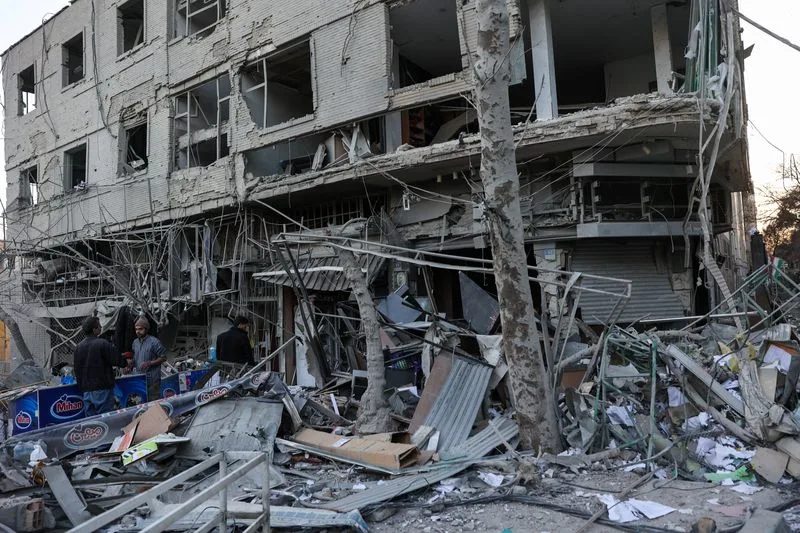
In Lebanon, Iran’s Hezbollah allies fired on Israel, which responded with air strikes and reinforcements of ground positions in the south. Thick black smoke blanketed Beirut as the sound of explosions rumbled. Authorities said dozens were killed.
Iran said deaths from the attacks had reached 787. That included 165 girls killed on the war’s first day when their school was bombed, the highest toll among several civilian targets reported to have been hit.
State media showed hundreds packing the streets of the southern city of Minab, where the girls’ small coffins, draped with Iranian flags, were passed from a truck and borne by the crowd across a sea of upraised hands towards the grave site.
The U.N. human rights office demanded an investigation into the strike, which its spokesperson called “absolutely horrific”.
Some Iranians have openly celebrated the death of Khamenei, 86, who had ruled Iran for 37 years and led security forces that killed thousands of anti-government protesters only weeks ago.
RUBIO SAYS WASHINGTON ATTACKED KNOWING ISRAEL WOULD STRIKE

While Israeli officials explicitly say they want to oust Iran’s government, U.S. officials have said the war’s aim is to destroy Iran’s ability to project force beyond its borders.
In a closed‑door briefing with foreign diplomats on Tuesday, Israeli Foreign Minister Gideon Saar declined to set a timeframe for the military campaign, acknowledging Iran’s government could survive the war but expressing confidence it would collapse later, sources said.
The minister’s office did not immediately respond to a request for comment.
Like Israeli Prime Minister Benjamin Netanyahu, Trump has urged Iranians to topple the clerical leadership, which has tormented the U.S. and its allies for generations, but on Tuesday the president urged caution.
“If you’re going to go out and protest, don’t do it yet. It’s very dangerous out there,” he said.
In Israel, where Iranian missiles have killed 10 people since Saturday, air-raid sirens sounded repeatedly, warning of incoming attacks and sending millions into bomb shelters as the blasts of interceptions shook buildings.