Revisiting North Korea’s Nuclear Tests
Revisiting North Korea’s Nuclear Tests
By baselining the first two tests and the last test, the author concludes that the three relatively more ambiguous tests (third, fourth and fifth) possibly employed more advanced designs than previously assessed. Given these parameters, North Korea may have already achieved a level of miniaturization sufficient for delivery by a wide range of missile systems. As such, despite ongoing predictions of a seventh nuclear test for the Hwasan-31 tactical nuclear warhead (revealed by state media in 2023 but never tested), testing may not be technically necessary.
However, if Pyongyang decides to resume nuclear weapons testing, a new cycle might not only involve tactical nuclear warheads, but possibly also a new generation of further miniaturized devices suitable for more use cases, such as multiple independently targetable re-entry vehicles (MIRVs).
Baselining Tests 1, 2 and 6
The possible design choices of the first two nuclear tests and the sixth test can be deduced from relatively more abundant reference points during the Six Party Talks era and more explicit state media claims and reports. While there is a vague consensus that North Korea likely began with a more advanced design than the WWII-era Nagasaki-type weapon, some experts remain skeptical that it has mastered gas-boosting. Because this article places greater weight on North Korea’s own statements rather than on perceived technical constraints, it treats the sixth nuclear test as having incorporated gas-boosting, as strongly suggested by Pyongyang’s strategic communications. North Korea’s late-mover advantages that could potentially facilitate such an effort are discussed below in the section on the fourth nuclear test.
Tests 1 & 2: Levitated Core
The DPRK conducted its first nuclear test in 2006. The test had a low estimated yield (estimates ranging from less than 1 kiloton up to 2 kilotons) in comparison with the yield of the first nuclear tests of established Nuclear Weapon States (over 20 kilotons). Further information indicated that the designed yield was only 4 kilotons.[2] A sub-kiloton yield would suggest that the test was not a fizzle but a success.[3]
The second DPRK nuclear test in 2009 had an estimated yield of a few kilotons, roughly reaching the alleged target yield of the 2006 test. A state media statement on the 2009 test said that:
The Democratic People’s Republic of Korea successfully conducted one more underground nuclear test on May 25…as requested by its scientists and technicians.
The current nuclear test was safely conducted on a new higher level in terms of its explosive power and technology of its control and the results of the test helped satisfactorily settle the scientific and technological problems arising in further increasing the power of nuclear weapons and steadily developing nuclear technology.
The quotes above appear to confirm that the second nuclear test was aimed to settle “scientific and technological problems” that led to the partial failure of the first test. It also marked the only instance that a nuclear test was said to be “requested” by North Korean scientists and technicians, further hinting that the 2009 test was a trouble-shooting attempt.
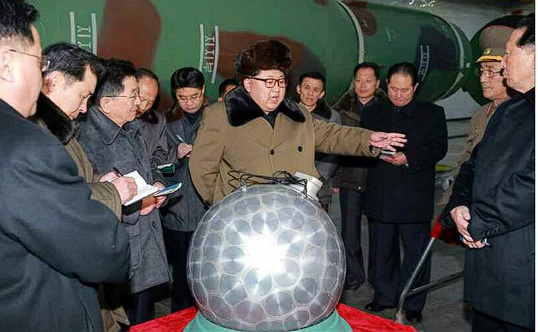
This reported small target yield indicates that the DPRK may have started its nuclear testing program with a compact design (in comparison to a Nagasaki-type device), so that the device could be made compatible with North Korean ballistic missiles of that era.[4] This small device assumption could also be supported by the size estimate of a purported early North Korean implosion device inspected by Kim Jong Il (Figure 1). The purported implosion device is estimated to have a diameter of roughly ~600 mm.[5]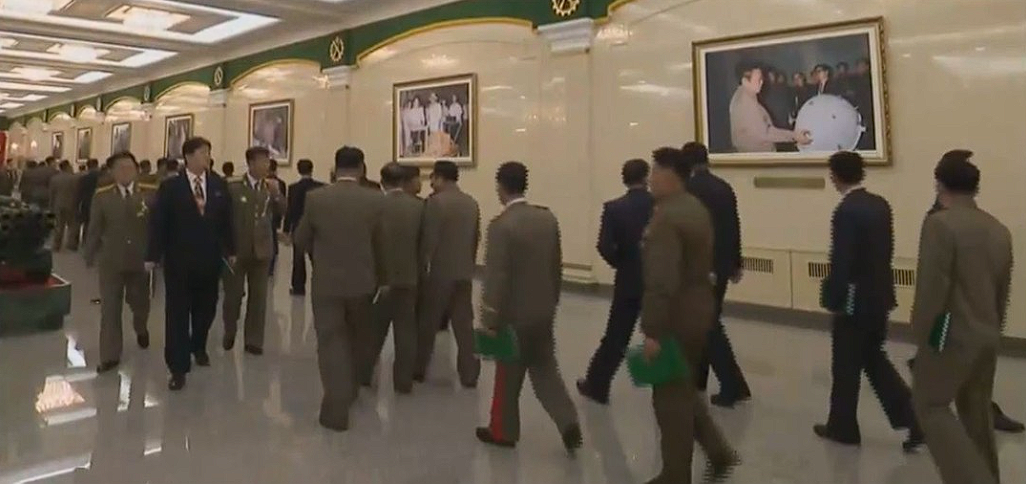
As a late mover, North Korea likely chose a levitated core design to make the compression of fissile material more efficient (Figure 2).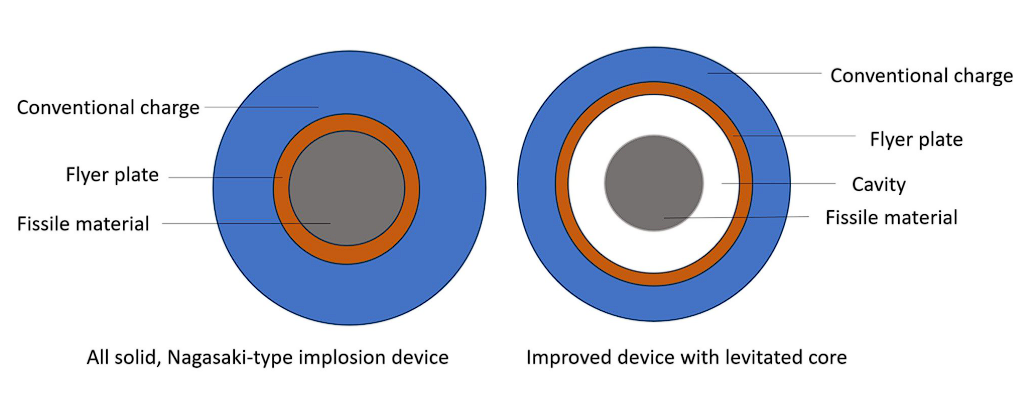
The concept of levitated pit was already well understood in the US during World War II, but was not chosen due to wartime constraints. The US quickly replaced the wartime design of all-solid, Nagasaki-type bombs with the levitated core after a series of nuclear tests conducted in the late 1940s. Recently published research revealed that China’s first atomic bomb, detonated in 1964, already used a levitated core.[7] According to Iran’s Atomic Archive, the country’s implosion design, developed between 1999 to 2003, also had a levitated core, which made it small enough to be delivered by Iran’s Shahab-3 mid-range ballistic missile (Iranian version of the North Korean Hwasong-7 ballistic missile). Thus, it is to believe that North Korea would have chosen a levitated core over the WWII-era Nagasaki-type design, effectively making the bomb smaller and possible to be delivered by North Korean ballistic missiles available at that time.[8]
Test 6: Hydrogen Bomb With Gas-Boosted Primary
Following the sixth nuclear test in 2017, the country’s Nuclear Weapons Institute issued a statement, saying:
The perfect success in the test of the H-bomb for ICBM clearly proved that…production technology of nuclear weapons of the DPRK has been put on a high level to adjust its destructive power in consideration of the targets and purposes.
On the same day of the sixth nuclear test, a separate state media report on Kim Jong Un’s guidance on nuclear weaponization stated that:
The H-bomb, the explosive power of which is adjustable from tens kiloton to hundreds kiloton, is a multi-functional thermonuclear nuke with great destructive power…
Adjusting yield according to needs is a distinctive feature of gas-boosted primary, in which the yield of a physical package is adjusted by the amount of deuterium-tritium gas released into a hollow core of fissile material (See Test 3 below).
In addition, the statement from the Nuclear Weapons Institute also appears to describe the detonation sequence of this two-stage thermonuclear weapon with a boosted primary:
Symmetrical compression of nuclear charge, its fission detonation and high-temperature nuclear fusion ignition, and the ensuing rapidly boosting fission-fusion reactions…were confirmed…
For reference:
- “Compression of nuclear charge”: Conventional explosives implode to compress the fissile material (nuclear charge) into a supercritical state.
- “Fission detonation and high-temperature nuclear fusion ignition”: Fissile material (nuclear charge) undergoes fission, and boosting gas starts fusion under high temperature, releasing a flood of neutrons to further boost the fission of the primary.
- “Ensuing rapidly boosting fission – fusion reactions”: The boosted fission of the primary triggers the fusion of the secondary.
Through official images and statements, North Korea clearly claimed that it managed to detonate an advanced thermonuclear weapon, intended for ICBM delivery, in the sixth nuclear test. If true, the North must have utilized the tests in between (Test 3, 4, 5) to achieve this technological leap.
The Tests In Between
If Test 6 involved a thermonuclear weapon with a gas-boosted primary as discussed above, at least one earlier test must have validated gas-boosting (most likely Test 4) and possibly a prior test validated an unboosted hollow-core design (Test 3). Such relatively advanced designs would have enabled North Korea to produce further miniaturized warheads suitable for a wider range of missiles. The perceived difficulties and advantages facilitating the pursuit of these advanced designs are discussed below.
Test 3: Improved Device With a Hollow Core?
A North Korean official statement said that the third nuclear test involved a new design with higher yield-to-weight ratio:
The test was conducted in a safe and perfect way on a high level with the use of a smaller and light A-bomb unlike the previous ones, yet with great explosive power…
The specific features of the function and explosive power of the A-bomb and all other measurements fully tallied with the values of the design, physically demonstrating the good performance of the DPRK’s nuclear deterrence that has become diversified.
It remains unclear what this new design “unlike previous ones” refers to. The estimated yield of the third test is around 6 to 7 kilotons, roughly doubling the estimated yield of the second test. If the statement of the bomb being smaller and lighter holds true, the third test would indeed represent a leap forward in North Korea’s weaponization.
Considering that, according to official North Korean statements, the sixth test involved a two-stage thermonuclear weapon with a gas-boosted primary, at least one gas-boosted fission device needed to be tested in either the fourth and/or the fifth tests (see below). Thus, one hypothesis for the third test would be that the North Korean engineers tested a hollow core design as a bridge toward a gas-boosted fission device (Figure 3).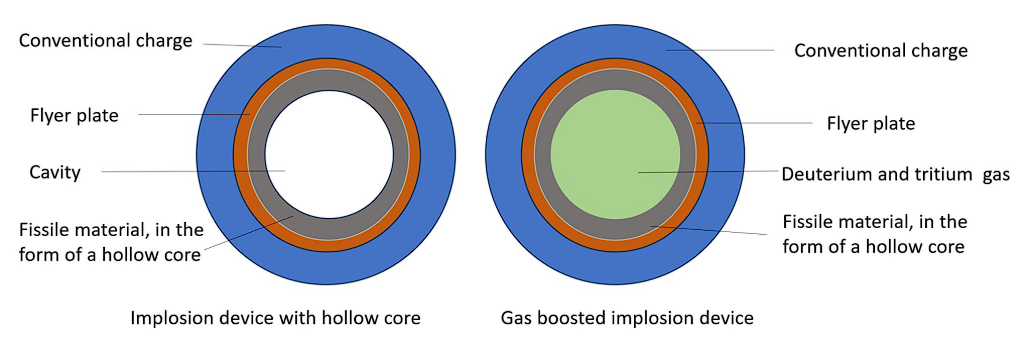
Testing a hollow core in the third test may sound like a daring hypothesis. In comparison, China, a latecomer in gas-boosting, only started experimenting with gas-boosted hollow cores in the 1980s. However, vacuum in the cavity not only allows higher acceleration for fissile material to crush into itself, but also eliminates complex instability issues at the boundary between solid material and gas during implosion.[10] This perceived simplicity might encourage North Korea to pursue an unboosted hollow core in its third test. If correct, this would suggest that North Korea was experimenting with more efficient core geometries earlier than previously assumed, accelerating its pathway toward gas-boosted designs.
Alternatively, an improved levitated core may have been used in the third test. Such improvements could include the increase of energy density of conventional explosives and the use of new, lighter (non-fissile) materials.
The wording that “DPRK’s nuclear deterrence has become diversified” has led to speculation that “diversified” could refer to the use of highly enriched uranium, though this cannot be confirmed by international atmospheric monitoring findings. Alternatively, the word “diversified” could mean that a “smaller and light” implosion device could be delivered by smaller ballistic missiles (for example, the ER-SCUD), or that the new design “unlike previous ones” diversified the designs of North Korean fission bombs (the “nuclear deterrence”).
Test 4: Introducing Gas-Boosting
To make the sixth nuclear test successful, there should have been at least one test to validate a gas-boosted implosion device among the third, fourth and fifth tests. According to the official statements, the fourth nuclear test better fits this criterion.
According to the official statement, the fourth nuclear test was of an “H-bomb” (commonly understood as a two-stage thermonuclear device). However, as this test did not demonstrate a typical H-bomb yield, the possibility of the tested device being a successful two-stage thermonuclear device was met with skepticism and it was speculated that a boosted-fission device may have been tested instead.
Unlike in 2017, when the DPRK made the specific claim that it had tested a two-stage thermonuclear device, the announcement of this fourth test used much more ambiguous language (quoted below). This appears to support suspicions that this test was more likely a boosted-fission device.
Through the test conducted with indigenous wisdom, technology and efforts the DPRK fully proved that the technological specifications of the newly developed H-bomb for the purpose of test were accurate and scientifically verified the power of smaller H-bomb.
It is noteworthy that the statement explicitly stated that the detonation was conducted “for the purpose of test” (thus distanced the test from weaponization). The term “smaller H-bomb” also implies that the device was not a full-fledged hydrogen bomb in its commonly understood term.
Nevertheless, gas-boosting in itself is a challenging technology. Unlike in an unboosted hollow core, instability issues at the boundary between solid material and gas during the implosion cannot be avoided. China only started testing gas-boosted primary in the 1980s, roughly two decades after the detonation of its first fission bomb. According to Hui Zhang’s newly-published book on the technical history of China’s weapon programs, the factors leading to the delay could be summarized as follows:
- China put most of its resources into the weaponization of its first-generation hydrogen bomb warheads (all using levitated core for the primary), most of which are heavy devices with megaton yield and are paired with large liquid-propellant ballistic missiles (DF-3, DF-4 and DF-5).
- Mao’s Culture Revolution disrupted and slowed down China’s nuclear weapon programs. After the end of the Culture Revolution, China accelerated the development of second-generation warheads and made breakthroughs in gas-boosting in the 1980s.
- Testing gas-boosted devices required more sensors to monitor and collect data than what China had in the earlier stages. However, quality fiber optic cables became widely available in the 1980s, filling this requirement.[11]
- Chinese designers apparently only discovered gas-boosting during their own calculation of physical models in 1979, suggesting a prior lack of open-source information on more efficient design ideas.[12]
While these elements delayed China’s progress toward gas-boosting, they do not appear to have been issues for North Korea’s programs. It is possible that North Korean designers fully exploited their late-mover advantage to pursue challenging but more efficient designs in the 2010s. If Test 4 validated gas-boosting, this would imply that North Korea had already mastered the key enabling technology for scalable, miniaturized weapons before 2017.
Kim Jong Un’s March 2016 Inspection
State media reported on March 9, 2016 that Kim Jong Un inspected work for mounting nuclear warheads on ballistic rockets on an unspecified date. During his inspection Kim was briefed on an implosion device referred to as “miniaturized powerful nuclear warhead with a Korean-style structure of mixed charge:”
Praising the nuclear scientists and technicians…he noted it is very gratifying to see the nuclear warheads with the Korean-style structure of mixed charge adequate for prompt thermo-nuclear reaction. The nuclear warheads have been standardized to be fit for ballistic rockets by miniaturizing them, he noted, adding this can be called true nuclear deterrent.
It is unclear what Kim Jong Un meant by “Korean-style structure of mixed charge.” Some possibilities include: 1) the use of composite fissile material, 2) mixed conventional charges[13] that initiate the compression of fissile material, or 3) both conventional and fissile material.
While there is no conclusion whether the inspected implosion device was more closely associated with the fourth or fifth nuclear test, the following observations may be able to serve as data points for this question:
- The term “thermo-nuclear reaction” in the report may indicate that the device inspected was a boosted-fission device. Alternatively, it could also be understood that this device was designed as the primary for a two-stage thermonuclear weapon, though at that time there was no indication that the North was working on such a device.
- The March 2016 report on Kim’s inspection was released two months after the fourth nuclear test and six months prior to the fifth nuclear test. The fifth nuclear test made no mention of “thermonuclear reaction.”
- The focus of the March 2016 report was Kim Jong Un’s guidance on mounting standardized nuclear warheads on various tactical and strategic ballistic missiles. This focus aligned with the stated goal of finalizing a standardized warhead in the fifth nuclear test (see below).
- The device shown in March 2016 had a size similar to the primary of the two-stage thermonuclear device showcased by state media on the occasion of North Korea’s sixth nuclear test in September 2017 (Figure 4). State media strongly implied that the September 2017 device employed a gas-boosted primary.
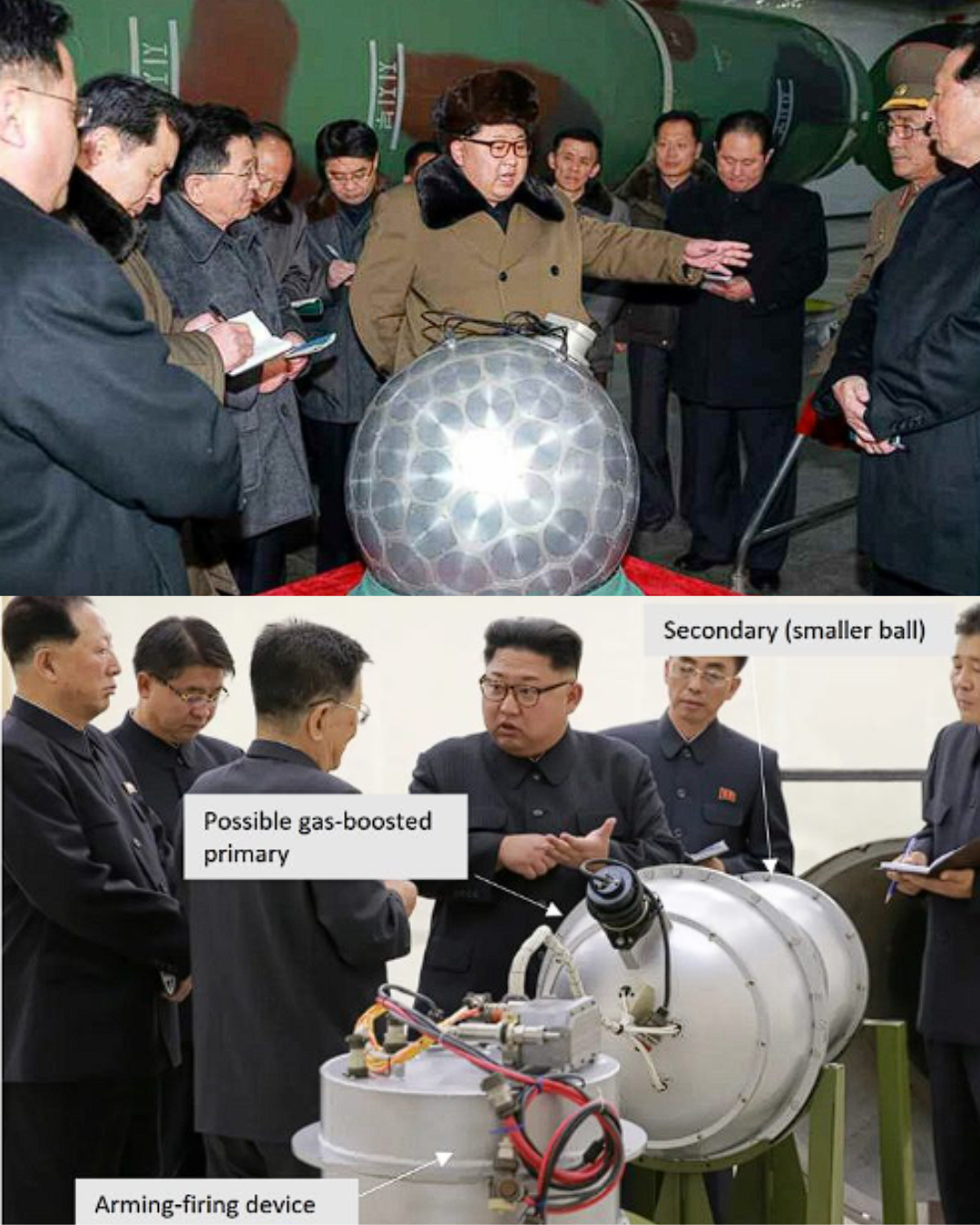 Figure 4. The implosion device shown in March 2016 (Left) has a size similar to the primary of the two-stage thermonuclear device shown in September 2017 (Right). (Source: Korean Central News Agency, annotated by author)
Test 5: Standardization Of Implosion Device
The official statement of the fifth test indicated that the test was aimed at finalizing or standardizing an implosion device for the Korean People’s Army Strategic Force. It was also the first time that North Korea explicitly mentioned the use of “various fissile materials,” indicating that uranium or a composite core of plutonium and uranium may have been used.
The nuclear test finally examined and confirmed the structure and specific features of movement of nuclear warhead that has been standardized to be able to be mounted on strategic ballistic rockets of the Hwasong artillery pieces units of the Strategic Force of the Korean People’s Army as well as its performance and power…
The standardization of the nuclear warhead will enable the DPRK to produce at will and as many as it wants a variety of smaller, lighter and diversified nuclear warheads of higher strike power with a firm hold on the technology for producing and using various fissile materials. This has definitely put on a higher level the DPRK’s technology of mounting nuclear warheads on ballistic rockets.
It is worth noting that state media gave no hints on whether the fifth test involved boosting. The statement’s expression that standardized warheads enable North Korea to produce “smaller, lighter and diversified nuclear warheads of higher strike power” reflects the key points of the statement on the third nuclear test (“smaller and light A-bomb” with “great explosive power” demonstrating “diversified nuclear deterrence”).
These two points indicate that the fifth nuclear test was possibly more closely associated with the third nuclear test, rather than a follow-up of the fourth nuclear test. On the other hand, the largest yield among the first five tests might serve as a weak sign for gas-boosting, especially if the fourth test did not meet its objectives fully.
Possible Nuclear Tests Timeline
After discussions on the possible development path of North Korean nuclear devices above, a timeline for the country’s testing program is compiled below (Table 1).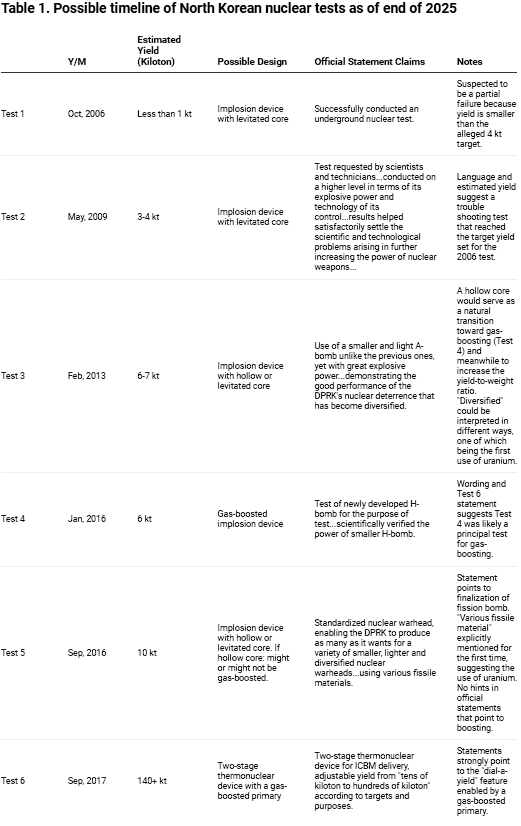
Conclusions And Implications
Based on 1) interpretations of official statements for each test, 2) available information on nuclear devices in the open source domain, 3) history of nuclear programs from other countries, and 4) North Korea’s considerable late mover advantage,[14] the author concludes that the three relatively more ambiguous tests (Test 3, 4, 5) may have employed more advanced designs than previously assessed, which include at least one gas-boosted device and possibly an associated pure fission device with a hollow core. These three tests further increased the devices’ yield-to-weight ratio, eventually leading to the test of a relatively compact, two-stage thermonuclear bomb in September 2017 (Test 6).
These conclusions would have the following implications:
- North Korea is able to mount compact nuclear devices on its strategic missile systems.
- If past nuclear tests were conducted on relatively high technological bases as discussed above, North Korea may have become confident enough in its ability to scale down the yield for a relatively small and simple tactical nuclear weapon,[15] such as the Hwasan-31 (revealed by state media in March 2023 but never tested[16]) without further testing.
- Almost nine years have passed since North Korea’s last nuclear test. During this period, the North is likely to have continued nuclear weapon research using non-fissile materials. Breakthroughs in conventional charges and other non-fissile material components could significantly reduce the overall weight and size of nuclear devices, facilitating delivery by smaller missiles and multiple reentry-vehicles. If the North Korean leadership makes a decision to start another testing cycle, the tests might not only validate a tactical nuclear warhead, but also involve a next generation of North Korean warheads suitable for more use cases, such as multiple independently targetable re-entry vehicles.
- [1]
This article disregards the possibility that these statements are disinformation (even though this possibility cannot be entirely ruled out), because without Pyongyang’s strategic communications, there is little basis for any analysis in the open-source domain except yield estimates and escapees’ accounts.
- [2]
Zhang Hui, Revisiting North Korea’s Nuclear Test, China Security, Vol.3 No.3, Summer 2007, available at: https://www.belfercenter.org/publication/revisiting-north-koreas-nuclear-test. Zhang stated that he confirmed with Christopher Hill, the chief US negotiator of the Six Party Talks, that Pyongyang had informed Chinese officials in advance of the test that the yield would be 4 kilotons; the New York Times reported that “a senior Bush administration official said he had learned through Asian contacts that the North Koreans had expected the detonation to have a force of about four kilotons.” See: William J. Broad and Mark Mazzetti, Blast May Be Only a Partial Success, Experts Say, New York Times, 10 October 2006, available at: https://www.nytimes.com/2006/10/10/world/asia/blast-may-be-only-a-partial-success-experts-say.html.
- [3]
Chinese experts stated that “if [the DPRK] aimed for 4 kilotons and got 1 kiloton that is not bad for a first test … we call it successful, but not perfect.” See: Siegfried Hecker, Report on North Korean Nuclear Program, Policy Forum Online 06-97A, Nautilus Institute, San Francisco, 2006; S.S. Hecker, R.L. Carlin and E.A. Serbin, A technical and political history of North Korea’s nuclear program over the past 26 years, Center for International Security and Cooperation, Stanford University, 24 May 2018, available at: https://fsi-live.s3.us-west-1.amazonaws.com/s3fs-public/narrativescombinedfinv2.pdf. The test was also judged as a partial failure by the US intelligence, see: Annual Threat Assessment of the U.S. Intelligence Community, US Government Printing Office, 2010.
- [4]
Richard L. Garwin and Frank N. von Hippel, A Technical Analysis: Deconstructing North Korea’s October 9 Nuclear Test, Arms Control Association, 7 March 2018, available at: https://www.armscontrol.org/act/2006-11/features/technical-analysis-deconstructing-north-korea%E2%80%99s-october-9-nuclear-test; Siegfried Hecker reportedly stated that the DPRK had most likely tested a more advanced design [than a Nagasaki-type design] at the risk of partial failure; see: Jonathan Medalia, Comprehensive Nuclear-Test-Ban Treaty: Background and Current Developments, Congressional Research Service, 18 September 2008, available at: https://www.ctbto.org/fileadmin/user_upload/pdf/External_Reports/RL33548.pdf. Other circumstantial evidence is that, in 2005, a high-level defector reportedly claimed that the DPRK was trying to reduce the mass of its atomic bomb from 1 ton to 500 kg. [특종] 北韓 최고인민회의 대의원 韓國에 망명, 核개발에 대한 중대 증언 [A member of the Supreme People’s Congress of North Korea defected to South Korea and gave a serious testimony about the development of the country], Monthly Chosun, August 2005, available at: http://monthly.chosun.com/client/news/viw.asp?ctcd=&nNewsNumb=200508100019.
- [5]
Though the confidence level of this measurement was relatively low due to low resolution and the suboptimal angle of the image.
- [6]
The cavity in levitated core designs is commonly described in the open-source literature as an “air gap” or “empty space.” A publicly available MIT course slide explicitly labels this region as a “vacuum space,” consistent with the hydrodynamic rationale for levitation. However, there is no declassified engineering documentation confirming the precise pressure state of this cavity in the open-source literature.
- [7]
Hui Zhang, The Untold Story of China’s Nuclear Weapon Development and Testing: A Technical History, London, MIT Press, 2026, 25-26.
- [8]
Such as the Hwasong-5/6/7 missiles; After conducting its third nuclear test, North Korea stated that it “neither needed nor planned to conduct a nuclear test,” because “the DPRK’s nuclear deterrence has already acquired trustworthy capability and enough strength to make a precision strike at bases of aggression…” The statement further said that the main objective of the third nuclear test is to express the resentment at the US hostile policies. While this statement attempts to justify its third nuclear test, it also serves as a hint that the North has completed the development of a basic and workable design through the first and second tests. See: Statement of the Spokesperson of the Ministry of Foreign Affairs of the Democratic People’s Republic of Korea, 12 February 2013, available at: https://docs.un.org/en/s/2013/91.
- [9]
China also possibly detonated an unboosted hollow core device in October 1982, before moving on to a test of a gas-boosted device in October 1983. See: Hui Zhang, The Untold Story of China’s Nuclear Weapon Development and Testing: A Technical History, London, MIT Press, 2026, 171-173.
- [10]
There is no confirmation on the pressure state of the cavity in a pure fission device with hollow core design. However, as the cavity serves the same purpose as the cavity in a levitated core design, it is plausible that the cavity in a pure fission device with a hollow core is also kept in a (near) vacuum state (See footnote 5).
- [11]
Hui Zhang, The Untold Story of China’s Nuclear Weapon Development and Testing: A Technical History, London, MIT Press, 2026, 170.
- [12]
Ibid, 169.
- [13]
The conventional charges in an implosion device could consist of fast and slow explosives.
- [14]
For example, the availability of commercially available fibre optic cables, higher computing capacity, more knowledge on general design ideas in open-source literature, and possible exchanges with Pakistan.
- [15]
Simple in the sense that the Hwasan-31 may not be a boosted device. Technical measures need to be taken to maintain the “dial-a-yield” feature of a boosted weapon due to radioactive decay of the boosting gas. As North Korea appears to be mass-deploying tactical nuclear strike weapons, these measures may cause logistic complexities or increase complexity of the tactical nuclear warheads.
- [16]
The Hwasan-31 is intended for a wide range nuclear weapon delivery systems (such as for the Hwasong-11 series aero-ballistic missiles, the 600 mm guided rockets, and land-attack cruise missiles). The Hwasan-31 is smaller than previously showcased nuclear devices and state media statements regarding the past six nuclear tests do not support the hypothesis that the Hwasan-31 warhead has ever been tested. For these reasons, the outside world has been anticipating a seventh test for this tactical nuclear warhead since it was first unveiled.