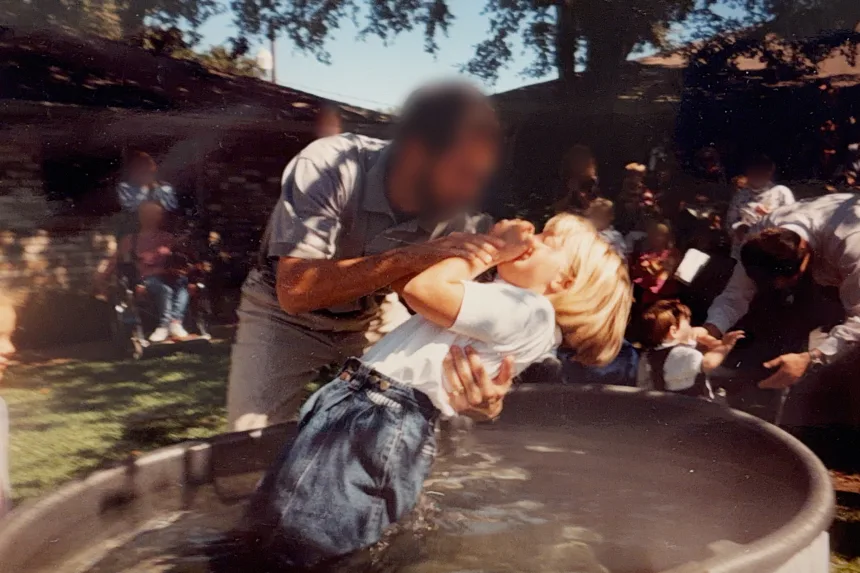

Katie wasn’t born into the life of a fundamentalist tradwife. But she welcomed the role as her family grew more conservative in the Christian church.
“I was very much all bought in,” she told CNN. “I loved my life. I was very happy and I felt very fulfilled.”
She wanted to be a good wife, to support her husband and bear his children — that much made sense to her. But the weight of the system, the control, the submission to husband, pastor, church, Jesus Christ and God, let alone the demands on women and children, threatened to crush her.
Twenty years later, Katie is now “deconstructing” her former life and beliefs, a process of examining, and often dismantling, previously held religious doctrines. She’s finding her own way in the world, but she worries about the women who feel stuck in their suffering.
She says she was almost broken by the fundamentalist system that promised God’s benevolence but brought her close to hell.
Becoming fundamentalist
Katie, who asked that her last name not to be published for privacy concerns, was born in Texas, deep in the Bible Belt of the Southern United States. She was the first child for her parents, two college graduates who were what she called culturally Christian and attended a non-denominational church in the Dallas area.
When she started to have attention issues in the 2nd grade (she said she had undiagnosed ADHD for decades), her mother decided to take her out of public school to educate her at home.

And when Katie was 9, the family moved south near Austin, where her mom continued to educate her and her younger brothers and sister. “She was really looking for community and friendship, and she found it in these more conservative circles,” Katie said.
Her mother found help and resources with other home-schooling residents and slowly the family entered the world of fundamentalism.
Katie said there was an emphasis on keeping girls modest, pure and deferential, and on young girls learning to cook and clean so they grew to be good housewives one day — and she embraced it.
As a teen, she ran a sewing class for younger girls. Her parents didn’t ban her from listening to the radio, but she didn’t want to blast out the pop music of the day. She listened on repeat to a cassette of Joshua Harris’ “I Kissed Dating Goodbye” book that promoted honoring God by staying pure before marriage.
She used the arguments she was learning to explain to others in her neighborhood why she did not date.
“I wanted to be able to talk about it and articulate it. It was this push where they wanted the girls to be pure. They talked a lot about how boys struggle with lust, and we want to care for our Christian brothers and not cause them to stumble.”
She lived in a bubble, she said, but not hidden from the world. It was just a world she didn’t want to join.
If a boy wanted to get to know her better, her response would be “ask my dad.” One young man, who’d been raised in a Mennonite community, did just that and that’s how she ended up entering a courtship.
‘I was excited to have babies immediately’
It wasn’t love at first sight, so Katie decided to fast and pray for a week to see whether God wanted her to court the young man for marriage. “Because I’m not really attracted to him necessarily, but he loves God and he’s really nice. And my dad has vetted him.”
After five days of fasting, Katie said she found herself having mental breakdowns and sobbing. But she came away with the feeling that courting was indeed in God’s wishes.

At the beginning, the couple would always be chaperoned by a third person. And even when they were allowed to be alone, Katie said she had no thoughts of breaking the rules. “We did not hold hands until we got married. We did not kiss until we got married,” she said. “We were both on board and agreed with it.”
And she was ready for what came next: “I was excited to have babies immediately.”
She became pregnant on the couple’s honeymoon and went on to have six children. “I was pregnant and/or nursing for 13 years,” she said.
The couple moved to the Middle East and worked as pastor and pastor’s wife, ministering to expatriates, learning Arabic and homeschooling their growing brood.
And still, Katie was all in. “Before that was a word, I was very much an enthusiastic tradwife.”
But the pressures of work, family and the expectations for how to live took their toll, not just on Katie but on her husband, too. She saw the other side of making men the authority for everything that happened under a family roof.
“This dynamic that we had had, that kind of worked OK for a really long time, started to disintegrate and so he was getting more stressed, and he really didn’t have any tools to handle that,” she said of her husband. He became verbally and emotionally abusive and the marriage spiraled down, even, Katie said, as she tried to follow her training to stay submissive and supportive.
“That’s what I thought was the best way,” she said. “I thought I was doing the thing that I was supposed to do to serve God, and I didn’t understand why it wasn’t working. And why was he being so mean to me? And why, like, why wasn’t it like changing my marriage?”
It began to affect her physically. “I started to deal with panic attacks,” she said. “I struggled with depression off and on. I started going to Christian counseling to help and my husband was supportive of that. So supportive that he sat in on the sessions with me.”
But while Katie remembers counselors telling her husband it was not OK to lose his temper with his wife, they did not offer solutions or hold him accountable. He would repent, she said, but not change his behavior.
Her perspective really changed when a friend — also a pastor’s wife — sent pictures of pages from a book she was reading about why some men are abusive.
“I read those pages, and it was like the in the movies where it zooms out and it’s quiet — a life-altering moment.”
That started the reawakening of Katie, or what she and other former fundamentalist wives call “deconstructing” their lives.
Leaving religion to find herself
Katie, now 39, is back in Texas with her children and her husband. Unusually in these situations, she said, he was also was able to rebuild his life and change his behavior over years of strife, separations, therapy and then healing.
It’s not that there is anything bad about being a stay-at-home mother, she says, it’s only if choice is taken away.

“We know how this progresses and what it looks like when you carry this idea and teaching and theology to its fullest extent. Like we’ve lived that, and it’s very toxic and very bad, especially towards women, especially towards minorities.”
Katie, who said she voted for President Donald Trump in 2020 but not in 2024, says she has a lot of empathy for people who have been swept up by the promises. “I was in it for so much of my adult life, and so, I understand what it was like to believe all of that, and I know why I believed that, and how I still felt like I was a good person.”
There was also a huge fear of taking a bet on another kind of life, but one that for her has paid off.
“I left religion and, it sounds cliché, I found myself. I found peace, I’ve found real peace. All these things that they promised us within these systems — peace and joy and freedom and just being a good person — I found those things outside of religion,” she said.
“They talk about leaving Christianity or deconstructing as a slippery slope … you start asking questions and you’re going to slide down the slippery slope of sin. I started asking these questions and I started sliding down and on the other side was freedom.”
Reflecting on her teenage self, she says there was nothing anyone could have said to her that would have changed her mind. She was certain about the path she was on.
That certainty is gone now, but she’s finding community in modern spaces like posting thoughts big and small on TikTok.
“I’m OK not knowing. And that’s such a huge thing when I spent my whole life being well, I need to know what the right thing is. And now I’m like, well, it’s OK to not know.”